
This Week in Earnings – Q3'25
Materials Sector Beat
Our thought leadership this week addresses:
- Key Events
- Earnings Snap, covering the S&P 500 stats to date
- Spotlight on Materials in The Sector Beat
Key Events
U.S. Unemployment
- Although the Department of Labor has not released the Unemployment Insurance Weekly Claims report since the start of the U.S. government shutdown, it has provided data for most states on initial jobless claims. Bloomberg analyzed that data, adjusting the raw figures with pre-released weekly seasonal factors from the Bureau of Labor Statistics, and found that initial claims fell to about 218,000 in the week ended October 25, down from a revised 231,000 the previous week. Continuing claims, a proxy for the number of people receiving benefits, slightly increased to 1.95 million in the week ended October 18 from 1.94 million. (Source: Bloomberg)
U.S. Government Shutdown
- The U.S. government shutdown has entered its sixth week, marking the longest in the nation’s history. With the Thanksgiving travel season approaching, concerns are mounting as airports and airlines report delays and cancellations due to air traffic control and TSA staffing shortages. In response, nearly 500 travel-related companies and organizations, including casinos, hotels, and convention bureaus, have urged the government to end the shutdown before the holidays. So far, the Federal Aviation Administration has reduced air traffic by 10% across 40 major airports, and Transportation Secretary Sean Duffy stated that U.S. airspace could be closed if officials deem air travel unsafe. (Source: Wall Street Journal)
ISM® Manufacturing and Services PMI® Reports
- October’s ISM® Manufacturing PMI® came in at 48.7, a 0.4% decrease from September’s 49.1%. In October, manufacturing activity showed mixed signals. The New Orders Index inched up to 49.4% from 48.9%, while the Production Index declined to 48.2% from 51%. The Price Index also fell to 58% from 61.9%. The Backlog of Orders Index rose to 47.9% from 46.2%, and the Employment Index improved slightly to 46%, up from 45.3% in September. (source: Institute for Supply Management)
- October’s ISM® Services PMI® came in at 52.4%, a 2.4% increase from 50% in September. The Business Activity Index rose to 54.3% from 49.9% in September. The New Orders Index reached 56.2%, up from 50.4% the previous month, marking its highest reading since October 2024. The Employment Index came in at 48.2%, a 1% increase from September’s 47.2%. (Source: Institute for Supply Management)
Energy
- Eight OPEC+ members — Algeria, Iraq, Kuwait, Saudi Arabia, the UAE, Kazakhstan, Oman, and Russia — met virtually on November 2 to review global market conditions and outlook. They agreed to raise crude output by 137,000 barrels per day (bpd) from the 1.65 million bpd additional voluntary adjustments announced in April 2023. The adjustment will take effect in December 2025, with the group set to meet again on November 30. (Source: OPEC)
S&P 500 Earnings Snap
85% of the S&P 500 has reported earnings to date
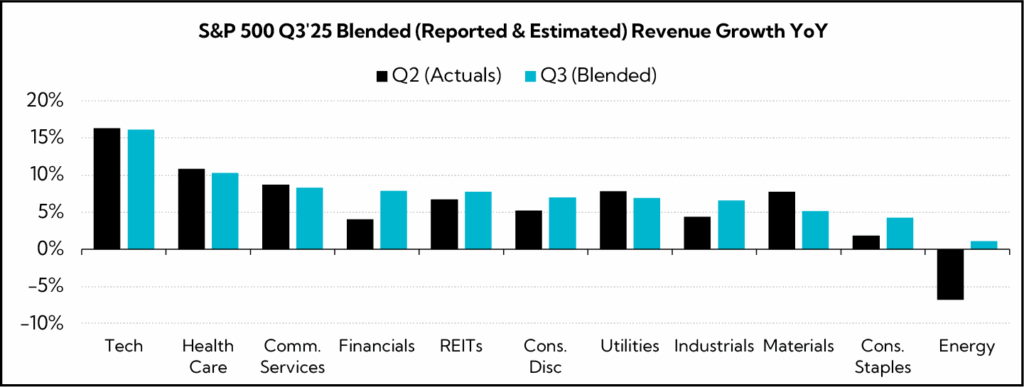
Q3'25 Revenue Performance
- 78% have reported a positive revenue surprise, above both the 1-year average (62%) and the 5-year average (70%)
- Blended revenue growth (combines actual reported results for companies and estimated results for companies yet to report) is 8.1% vs 6.4% in Q2
- Companies are reporting revenue 2.4% above consensus estimates, above both the 1-year average (+0.9%) and the 5-year average (+2.1%)
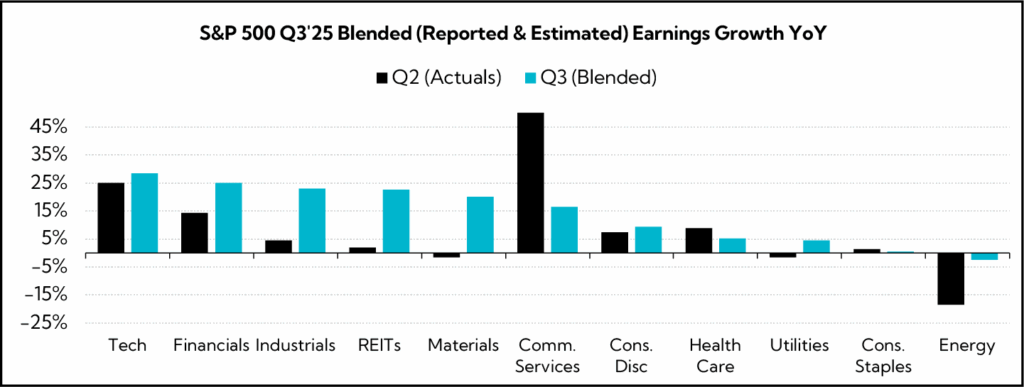
Q3’25 EPS Performance
- 83% have reported a positive EPS surprise, above both the 1-year average (77%) and the 5-year average (78%)
- Blended earnings growth (combines actual reported results for companies and estimated results for companies yet to report) is 16.8% vs. 13.8% in Q2
- Companies are reporting earnings 10.4% above consensus estimates, above the 1-year average (+6.3%), but below the 5-year average (+9.1%)
The Sector Beat: Materials
Materials Guidance Trends
We analyzed annual revenue and EPS guidance for a basket of U.S. Materials companies with market caps greater than $1B that have reported to date.1 Below are our findings. For comparison purposes, we provide an “All-Company” benchmark, which tracks in real-time a basket of calendar year companies larger than $1B in market cap across all sectors that have reported earnings to date (n = 727)2.
Guidance Breakdown by Industry
| Industry | Number of Companies |
|---|---|
| Chemicals | 13 |
| Containers & Packaging | 7 |
| Metals & Mining | 3 |
| Construction Materials | 2 |
| Total | 25 |
Source: Corbin Advisors
Revenue Guidance
To date, half of the Materials companies providing 2025 outlooks have Lowered annual revenue guidance, more than double the All-Company benchmark. Companies cite weakening demand, tariff uncertainty, inventory destocking, and competitive pricing as reasons for lowering guidance. Only 14% of materials have Raised revenue guidance compared to almost half of the All-Company benchmark.
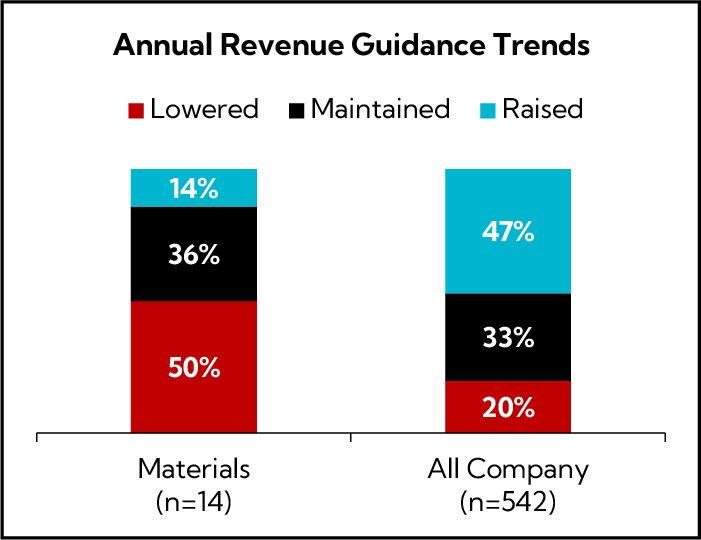
- Companies that Lowered guidance (n = 7)
- Majority lowered the top and bottom of the original range; 2 lowered the top and maintained the bottom and 1 raised the bottom and lowered the top (decreased midpoint)
- Average midpoint of (1.9%) growth versus 2.6% last quarter3
- Average spread decreased by 280 bps to 2.8%
- Companies that Maintained guidance (n = 5)
- Average midpoint of 4.0% growth
- Average spread of 2.5%
- Companies that Raised guidance (n = 2)
- 1 company raised both bottom and top of the original range and 1 company only raised the bottom and maintained the top
- Midpoint of 7.7% growth versus 6.9% last quarter
- Spread decreased by 100 bps to 0.6%
EPS Guidance
Similarly, 40% of Materials companies Lowered annual EPS guidance, doubling the All-Company benchmark. The remaining Materials companies are evenly split between Raising and Maintaining.
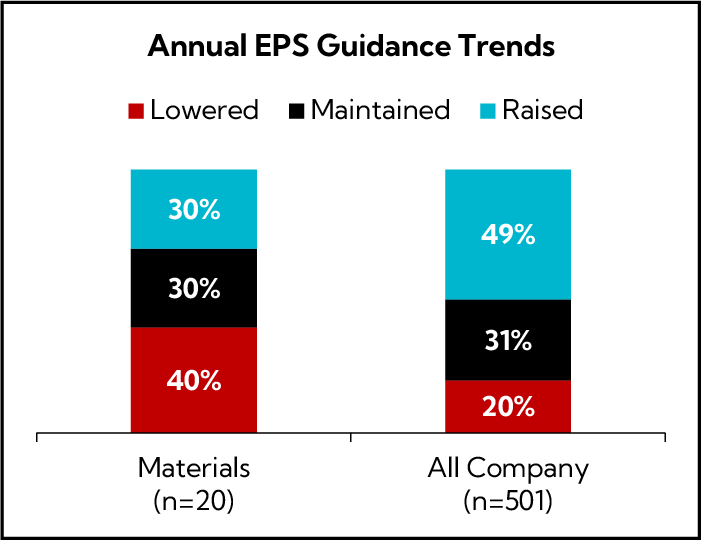
- Companies that Lowered guidance (n = 8)
- Nearly all companies lowered the top and bottom of the range; 1 company lowered the top, but maintained the top
- Average spread decreased from $0.31 to $0.16
- Companies that Maintained guidance (n = 6)
- Average spread of $0.24
- Companies that Raised guidance (n = 6)
- Nearly all companies raised top and bottom of the original range; 1 company lowered top while raising bottom
- Average spread decreased from $0.25 to $0.09
Earnings Call Analysis
We analyzed earnings call prepared remarks and Q&A for this group and the broader Materials sector universe to identify key themes.
Executives across the sector describe a subdued operating environment marked by limited visibility, persistent trade uncertainty, and constrained consumer spending amid affordability pressures. Although recent monetary easing and the early stages of a rate-cutting cycle are beginning to provide some hope for relief, most companies expect a gradual and uneven recovery. Indeed, while 76% and 79% of Materials have surpassed top- and bottom-line estimates, respectively, nearly half of the sector have Lowered both full year revenue and EPS guidance, more than double the All-Company benchmark. Still, long-term structural tailwinds — such as infrastructure investment, reshoring of industrial capacity, the energy transition, and AI-driven development — are viewed as bright spots for eventual growth once macro conditions stabilize.
In the near term, demand trends across end markets remain mixed, highlighting a bifurcated landscape. Infrastructure, energy, and defense-related sectors continue to show resilience, buoyed by government investment and secular spending programs, while residential construction, automotive, and consumer markets remain in cyclical troughs. During this continued uncertainty, management teams are emphasizing cost control, productivity, and product innovation to sustain margins and strengthen positioning ahead of an eventual rebound.
Trade and tariff dynamics continue to reshape global supply chains and pricing behavior. Protective measures such as Section 232 tariffs have benefited U.S. steel producers and reinforced domestic manufacturing competitiveness. However, broader trade uncertainty continues to weigh on demand, particularly in Asia-Pacific, where shifting trade flows and retaliatory measures have created volatility. Companies are mitigating these pressures through pricing actions, supplier diversification, and localized production strategies, while maintaining cautious optimism that trade frameworks will eventually stabilize. The model of “make-in-region, sell-in-region” continues to be a trend.
Across the industry, companies are also managing through a prolonged inventory correction cycle. Elevated stock levels — stemming from prior overproduction, tariff-related prebuys, and weaker-than-expected demand — have pressured volumes and pricing. Several companies reported ongoing destocking through customer channels and proactive internal inventory reductions to better align with market conditions. In parallel, capacity rationalization efforts signal an industry-wide move toward restoring balance. These actions are expected to gradually normalize market fundamentals into 2026.
Regionally, demand remains uneven and mirrors broader macro imbalances. North America continues to show relative stability supported by infrastructure and export strength, while Europe faces persistent weakness tied to industrial contraction and import pressure from Asia. China’s overcapacity and sluggish domestic consumption remain key global headwinds, suppressing pricing power and distorting trade flows across the materials value chain.
Against this backdrop, Material companies are positioning themselves for a slow but eventual recovery. As one company observed, while “a broader recovery has yet to take hold,” early signs of stabilization and monetary easing should “begin to more positively influence demand.”
Key Earnings Themes
Macro and Outlooks
A Sluggish Backdrop Remains Marked by Cautious Customer Behavior and Global Trade Uncertainty; Long-term Structural Tailwinds and Easing Monetary Policy Offer a Glimpse of Optimism for Recovery, but Trends Described as “Unchanged” for Now
- Dow ($15.1B, Chemicals): “The broader macroeconomic landscape remains largely unchanged since our last update. As it relates to Dow’s key market verticals, while we are seeing some pockets of stability, a broader recovery has yet to take hold. Based on the visibility we have from current customer orders, we continue to see a cautious operating environment. Business investment and consumer spending are subdued due to ongoing economic uncertainty and affordability challenges. These dynamics are impacting demand across several key end markets. At the same time, recent monetary policy shifts and the beginning of a rate-cutting cycle do begin to more positively influence demand.”
- Commercial Metals ($5.8B, Metals & Mining): “When we look beyond the current environment, we remain confident that the emerging structural drivers will support construction activity over a multi-year period. These trends include investment in our nation’s infrastructure, reshoring industrial capacity, growth in energy generation and transmission, the build-out of AI infrastructure, as well as addressing a U.S. housing shortage of 2M to 4M units.”
- Cabot ($4.1B, Chemicals): “Fiscal year 2025 certainly developed differently than we expected just one year ago. Automotive production in the Western economies contracted in 2025 and elevated Asian tire imports into Western geographies continue to persist. Additionally, global manufacturing PMI was in or near contraction territory for most of 2025. And the expected interest rate cut cycle was slower than expected, leaving the housing and construction sector in a trough. In addition, 2025 is characterized by global trade turbulence, which is making it very difficult to determine long-term durable demand levels. As we look to 2026, we don’t yet see signs of improvement across these dimensions. While trade policy is trending toward regionalization and this aligns well with our model of make-in-region, sell-in-region, it will likely take some time for end markets and supply chains to find their new normal.“
- Quaker Houghton ($2.2B, Chemicals): “Macroeconomic trends have remained soft through 2025 and we expect them to remain so at least through Q4. We also expect a return to normal seasonal trends in Q4 and there is lingering uncertainty that continues to weigh on customer operating rates from tariffs and global trade. We anticipate continued momentum driven by share gains, and our ongoing cost actions will help mitigate these impacts.”
- Avient ($3.1B, Chemicals): “General market conditions remain largely unchanged from August. This includes an uncertain global macro environment where customers in most markets and regions are waiting for clarity on trade policies, geopolitics is fast reshaping global businesses and supply chains, and the war in Europe continues.”
Mixed Demand Signals
Infrastructure, Energy, AI, and Defense Remain Bright Spots Amid Broad Demand Softness Across Construction, Housing, and Consumer Markets
- Commercial Metals ($5.8B, Metals & Mining): “Infrastructure has been very strong. It has been for the past several years, really on the back of the IIJA, and we expect it’s going to continue to be strong. Non-residential construction [has] been a bit mixed. There have been certain areas that are very strong, areas like energy, data centers, institutional spending on hospitals. But then there have been other areas that are weaker and I’m thinking about commercial buildings, retail has been weaker. The thing that’s exciting about the non-residential space is that there is a huge backlog of potential projects coming down the pike.”
- Cabot ($4.1B, Chemicals): “While end market demand in construction and auto remains in a cyclical trough, we are seeing strong and improving demand in attractive end markets like battery materials, as well as specific sectors, including infrastructure and alternative energy, digitalization and consumer-driven applications.”
- Sherwin-Williams ($87.4B, Chemicals): “From a demand perspective, it appears that a very challenging environment will persist through the first half of the year and most likely beyond that. Softer for longer and continued choppiness across most end markets. The leading indicators we track point to minimal positive catalysts at this time.”
- Reliance ($15B, Metals & Mining): “Shipments for [non-resi construction] products were seasonally strong in [Q3] and increased [YoY], driven by strong demand in public infrastructure work, including civil projects, schools, hospitals and airports, as well as ongoing data center construction. Shipments in [general manufacturing] also increased YoY as military, industrial machinery, consumer products, shipbuilding and rail sector shipments were seasonally strong. Relative weakness in agricultural machinery continued. Demand on the commercial side was down slightly due to pent up inventory in the supply chain, while demand in defense and space-related aerospace programs remain consistent at strong levels.”
- Avient ($3.1B, Chemicals):”Overall, for Q4, we expect growth in our color, additives, and inks business to be under pressure due to the subdued market demand for packaging and consumer applications, while our specialty engineered materials business is expected to grow, supported by customer demand and growth of some of our recently launched innovative products in healthcare and defense markets. Though we remain cautiously optimistic that end market demand will improve in the near future, there continue to be many unknowns and uncertainties surrounding our macro. Accordingly, we are proactively working on an action plan in the event that the slow or no growth period ensues for an extended period. This includes additional productivity actions and organizational complexity reduction so we can continue to grow our margins and earnings.”
Tariffs
Trade and Tariff Policies Remain a Double-edged Sword — Bolstering U.S. Production but Sustaining Global Uncertainty that Tempers Demand and Reshapes Supply Chains, Pricing Strategies, and Competitive Dynamics
- Sensient Technologies ($4.9B, Chemicals): “The current trade and tariff landscape has introduced additional complexity and uncertainty to our businesses. While we have already taken price to offset the impacts of the initial wave of tariffs and we’ll continue to take these pricing actions into next year, we have witnessed some demand and volume disruptions in some areas of our business due to this uncertainty, particularly in Asia Pacific. We’ll continue to position our supply chain organization to minimize any disruptions to our customers and optimize the flow of goods”
- Nucor ($31.8B, Metals & Mining): “Turning to trade policy, we’ve seen meaningful federal action this year supporting the American steel industry. Section 232 measures and ongoing trade enforcement are curbing imports, with finished steel imports down nearly 11% YTD through August. Since the broader Section 232 tariffs were implemented, we have seen larger MoM reductions in imports and expect the trend to continue. While imports have decreased since the comprehensive 50% steel tariffs went into effect, they continue to be a necessary tool to counteract the massive amounts of overcapacity that persist in the global steel sector. We believe the tariffs must stay in place with no exceptions or loopholes until there are fundamental changes in the global steel industry.”
- TriMas ($1.4B, Containers & Packaging): “Our teams continued to navigate direct tariff impacts effectively through proactive commercial strategies, including pricing adjustments and supplier negotiations.”
- Minerals Technologies ($1.8B, Chemicals): “Higher pricing of $1 million offset inflationary input costs, including higher tariff costs in Q3. Versus Q3 last year, we’ve done well to offset $10 million of higher costs, including tariff costs, raw material increases, energy and temporary increases like higher logistics costs associated with our U.S. cat litter plant upgrade. We offset these cost increases with a combination of productivity improvements, supply chain actions, price increases and our cost savings program. And I would also highlight that as we move through the temporary cost increases, we should see margin improvement from these actions going forward.”
- Reliance ($15B, Metals & Mining): “Trade policy uncertainty has contributed to temporary headwinds to gross profit margins since May of this year for most carbon steel products. Tariffs initially drove rapid price increases for carbon steel products, which slightly elevated carbon steel margins. But without a corresponding increase in demand and plenty of inventory availability in the supply chain, we encountered a very competitive pricing environment, which led to Q3 margin decline for carbon product from somewhat elevated levels in H1.”
- Crown Holdings ($11.6B, Containers & Packaging): “We have seen limited direct impact from tariffs and remain attentive to the indirect effects that tariffs have had on the global consumer and industrial demand.”
Inventory
Companies are Actively Managing through an Extended Inventory Correction Cycle Driven by Weak Demand and Prior Overproduction, but Disciplined Destocking and Capacity Rationalization are Paving the Way for Balance and Recovery
- Dow ($15.1B, Chemicals): “The prolonged downcycle continues to weigh on our entire industry, but we’re starting to see some encouraging actions in response, most notably around addressing industry oversupply. Specifically, announcements to date include significant rationalization of global ethylene, propylene oxide and siloxane capacities, each of which will benefit Dow’s diversified portfolio. As we have experienced through prior downcycles, we expect to see additional announcements and actions until more visible signs of recovery begin to materialize. As it relates to anticompetitive oversupply activities, our teams continue to be actively engaged in conversations with governments around the world to mitigate impact, aggressively defend local production, and to ensure a fair trade environment remains.”
- Eastman Chemical ($7B, Chemicals): “The trade disputes have exaggerated this dynamic with all the pull forward of material that happened in H1 to get ahead of tariff risk. And now with consumer demand being sort of weaker than was expected in H1, for p, it’s taking a lot longer to unwind that inventory.”
- PPG Industries ($23.9B, Chemicals): “With all the tariff uncertainty, at first we did pre-buy a bunch of raw materials to capture it at a good price. That bought us time to work through other tariff mitigation actions so that we can control our inflation to that LSD number as we move through the year. We fully expect that the inventory piece of it will normalize by year-end.“
- AptarGroup ($9.1B, Containers & Packaging): “For Q4 2025, we expect a more pronounced deceleration, mainly due to elevated inventory levels at a large customer. While demand from other customers remains healthy, we expect this inventory normalization to extend into 2026.”
- Silgan Holdings ($5B, Containers & Packaging): “As 2025 has progressed, it has become clear that North American consumer trends have become more bifurcated with certain high-end products continuing to perform very well, while other products appear to have been impacted by a subset of the North American consumer that is stretched by both inflation and muted wage growth. Given the growth trend in 2025 fell below expectations, our customers have shifted priorities in Q4 to more closely align their inventories exiting the year with the levels of demand they have experienced throughout 2025. As a result, we are now expecting Dispensing and Specialty Closures and Custom Containers volumes to decline by a mid-single-digit percentage in Q4 and have proactively taken the step of reducing our own inventories in Q4 as well.”
- International Flavors & Fragrances ($16.2B, Chemicals): “There’s a lot of uncertainty with our customers and they’re trying to operate with lower inventory levels. We absolutely can and will do a better job of managing our inventory levels. We’re really trying to stay close to our customers and understand what their needs are, so that we’re able to operate with lower inventories but not miss any delivery reliability goals.”
Around the World
Regional Demand Remains Uneven — North America Relatively Stable, Europe Subdued, and China’s Excess Capacity Weighing on Global Balance…the Consumer Globally is Losing Steam
- Dow ($15.1B, Chemicals): “In our packaging market vertical, global demand remains steady. Industry growth in North America was supported by record September domestic and export volumes. Manufacturing activity in China continues to be modest, while Europe contracted in September. In the infrastructure sector, market conditions remain soft across the U.S., Europe and China. In the U.S., 30-year mortgage rates have eased modestly but remain above 6% this month. Demand is unlikely to increase in the near term due to limited affordability, but lower mortgage rates could spur a recovery in 2026 as conditions improve.”
- Commercial Metals ($5.8B, Metals & Mining): “For our Europe Steel Group, conditions improved modestly from Q3. Demand continued to normalize as a result of solid Polish economic growth, while on the supply side, import flows ticked up slightly from recent quarters, but remain below the disruptive levels of a year ago. We are encouraged by recent developments that the EU is looking to bolster its trade legislation with the implementation of a long-term mechanism that will reduce existing quotas for foreign steel by nearly half. And imports beyond those quotas would be subject to new higher tariffs, which are currently proposed at 50%.”
- Eastman Chemical ($7B, Chemicals): “The China market is uniquely challenged as part of the global challenge where they don’t have consumer demand growing very much there because of the stress of the collapse of the housing market. And they’re adding lot of manufacturing capacity and aggressively exporting, and that’s creating strain in the country, and it’s also creating strain around the world, which is leading to these tariffs that you start seeing happen not just here, but you’re going to see them in other countries. Their excess capacity is not helping their local economy or the world’s economy. And hopefully some of the actions they’re talking about to…rationalize capacity to be more appropriate, that they actually do.”
- Cabot ($4.1B, Chemicals): “Regarding Performance Chemicals, in 2025, we have seen rather strong demand in Asia, muted levels of demand in the Americas and challenging demand patterns in Europe. We anticipate these trends will continue in 2026. The challenges in Europe are also related to end product imports from Asia into Europe, which is impacting demand pull-through from our customers in the region.”
- Avient ($3.1B, Chemicals): “Packaging demand was lower than anticipated, especially in EMEA, our largest packaging market. Consumer sales were down high single digits in Q3. Notably, the weakness in consumer demand was broad-based globally. Following a weak Q2, we had expected continued negative growth in Q3, but the customer demand was weaker than what we had anticipated in Asia where our consumer sales ended being down double digits for the quarter. Having said that, we did see some encouraging trends for our global consumer business in September, and while it is too early to call if it is inflecting to growth, we do expect YoY consumer sales performance to be better in Q4.”
In Closing
Our analysis finds that fundamentals across the Materials sector remain challenged, as companies continue to navigate a landscape defined by persistent trade uncertainty, constrained consumer spending, excess inventory, and softer-for-longer demand dynamics.
Looking ahead, while a sluggish macro and customer demand remain unchanged, the combination of monetary easing, a few early signs of industrial stabilization, and improving order trends in select markets is expected to slowly support demand normalization.
Over the medium term, structural investment themes—particularly in infrastructure, energy transition, defense, and AI—are expected to underpin growth bright spots. Companies are increasingly aligning their portfolios and regional footprints to capture these opportunities while maintaining a disciplined focus on cost efficiency and productivity amid uneven global demand. At the same time, trade policy shifts and China’s persistent overcapacity (aka dumping) remain key external variables shaping competitiveness and pricing.
Overall, the sector enters 2026 with a more cautious tone than other sectors. As we have shared previously, this sector is one that underpins the global economy and is one of our closely followed canaries-in-the-coal-mine. We’ll be watching closely for further signals of demand normalization and sentiment shifts as the new year begins.
In the meantime, stay tuned for our Closing the Quarter piece next week, rounding out the Q3’25 earnings season!
- $1B in market cap
- As of 10:30am ET 11/6/25
- Excluding DuPont which was an outlier