
This Week in Earnings – Q1'26
Industrials Sector Beat
Our thought leadership this week addresses:
- Key Events this week
- Earnings Snap, covering S&P 500 stats to date
- The Sector Beat – Industrials, which provides valuable insight on the economic picture, deal environment, and communication trends
Key Events
Iran War
- Following the announcement last Friday that the Strait of Hormuz was open to all commercial travel, Iran once again closed the critical sea passage in retaliation for the continued U.S. naval blockade. Iranian officials cited “repeated breaches of trust”, as negotiations to secure a long-term deal failed to materialize. (Source: WSJ, Reuters, Bloomberg, CNBC)
Kevin Warsh Nomination Hearing
- President Trump’s pick to replace the current Chair of the Federal Reserve, Kevin Warsh, testified before the Senate Banking Committee this week. During his prepared remarks, Warsh reaffirmed that monetary policy must remain “strictly independent”, but also argued that independence is contingent on the Fed staying within the narrow remit of its mandate and doesn’t drift into political or quasi-fiscal activity. Throughout the hearing, Warsh emphasized three things: 1) the Federal Reserve must restore credibility after the inflation miss from 2022, 2) it should reexamine how it communicates and which inflation measures it emphasizes, and 3) it should become much more focused on interest rates, rather than balance sheet activism, as a means to achieve both sides of its mandate. (Source: WSJ, Reuters, Bloomberg, CNBC)
U.S. Economic Data
- U.S. Initial Jobless Claims for the week through April 18th came in marginally higher than the 210K estimated at 214K, reflecting a stable employment picture. However, the “low hire, low fire” dynamic still exists, with March data from the New York Fed showing the expected likelihood of moving to a new employer fell to the lowest level in five years. (Source: WSJ, Federal Reserve, DOL)
- U.S. Retail Sales for March surprised to the upside, increasing to 1.7% MoM or 4.0% YoY. The increase was largely driven by a record surge in service station receipts, with spending supported by tax refunds. (Source: WSJ, Reuters, Department of Commerce)
- The S&P Global U.S. Manufacturing PMI rose to 54.0 in April, up from 52.3 in March, surpassing economist expectations of 52.5. This marked the largest improvement in factory business since May 2022. Survey respondents also noted that supplier delivery times lengthened significantly, the most since August 2022. (Source: S&P Global, Trading Economics)
Meta and Microsoft Announce Layoffs
- Meta announced layoffs of approximately 8,000 employees, roughly 10% of its workforce, this week as the social media company seeks to tighten operations and redirect resources to AI-themed investments. Severance is reported to include 16 weeks of base pay plus 2 additional weeks per year of service. (Source: WSJ, Reuters, Bloomberg, CNBC)
- Similarly, Microsoft reported launching its first-ever Voluntary Retirement Program, basing eligibility on a “Rule of 70”, where age plus years of service must be equal to or greater than 70. Reports indicate that roughly 7% of Microsoft’s employees meet this criterion. (Source: WSJ, Reuters, Bloomberg, CNBC)
European Union Approves €90 Billion Loan to Ukraine
- Following two months of delays, the EU has given final approval for a €90B loan to Ukraine to support its ongoing war with Russia. The impasse ended after Hungary lifted its veto, two days after Ukraine announced that the Druzhba Pipeline, which carries Russian oil to Hungary and Slovakia, had been repaired. Outgoing Hungarian Prime Minister Viktor Orban made his dispute with Zelenskyy over Druzhba a central theme in his re-election campaign. (Source: Reuters, New York Times, Bloomberg, Euro News)
Earnings Snap
28% of the S&P 500 has reported earnings to date
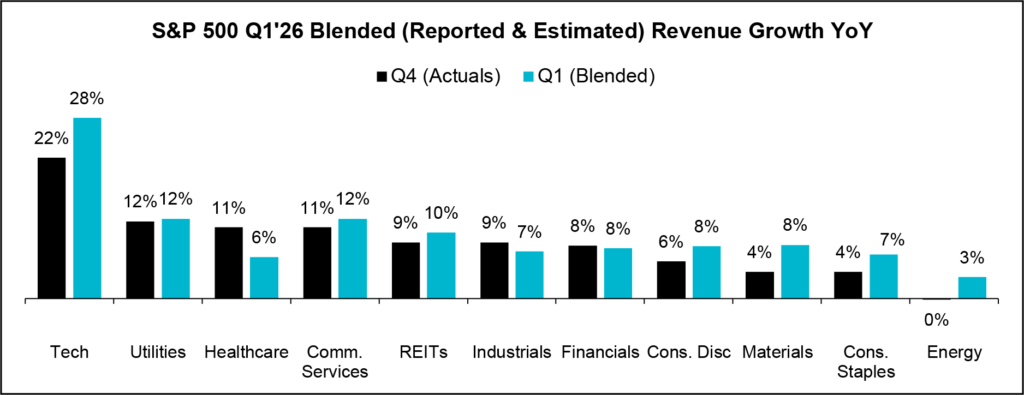
Q1'26 Revenue Performance
- 77% have reported a positive revenue surprise, marking the fourth consecutive quarter in which 70%+ of the S&P 500 surprised on the top-line to date
- Blended revenue growth (combines actual reported results for companies and estimated results for companies yet to report) is 9.7%
- Companies are reporting revenue 2.1% above consensus estimates
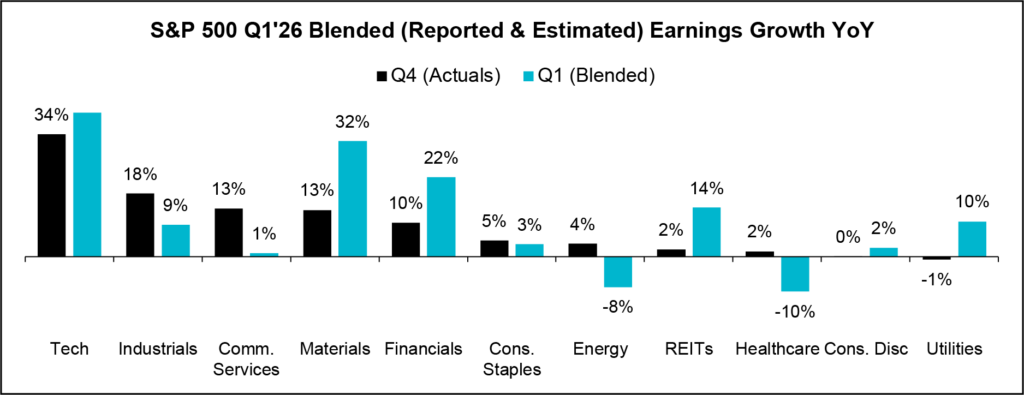
Q1’26 EPS Performance
- 81% have reported a positive EPS surprise, the second greatest proportion of EPS surprises for the S&P 500 in eight quarters
- Blended EPS growth is 16.1%
- Companies are reporting earnings 9.2% above consensus estimates
The Sector Beat: Industrials
Industrial Guidance: Initial Trends
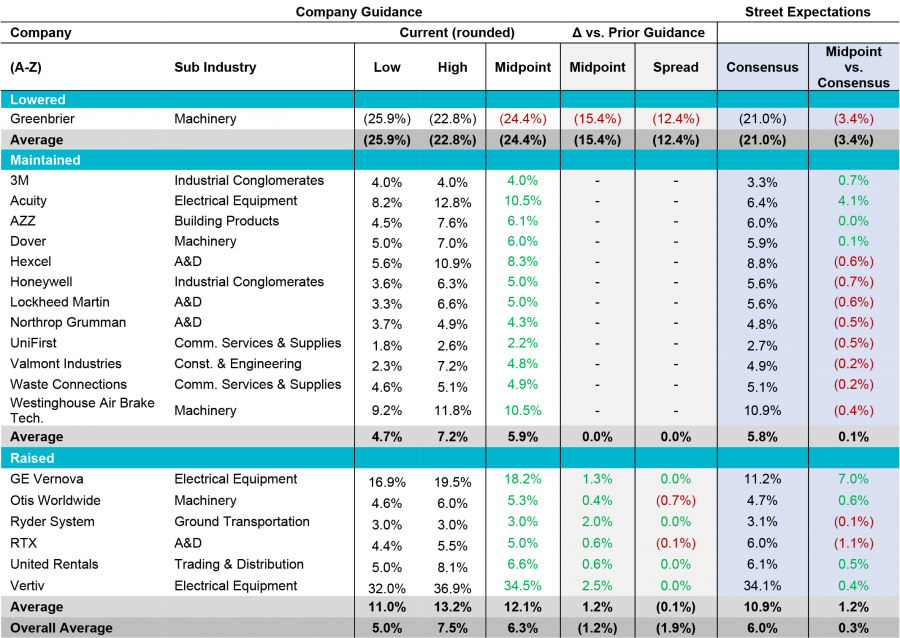
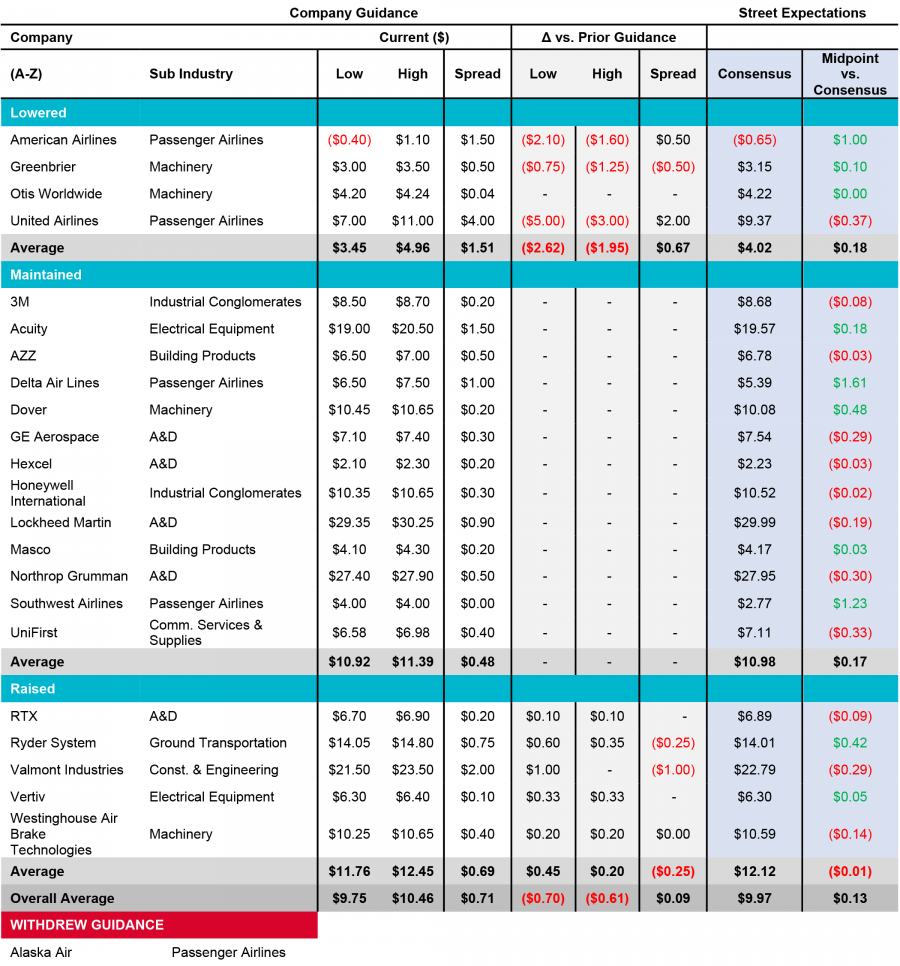
At the beginning of each quarter, we analyze annual revenue and EPS guidance spreads provided by calendar year Industrial companies with market caps greater than $1B that have reported to date.1 Below are our findings.
Guidance Breakdown by Industry1
| Industry | Number of Companies |
|---|---|
| Aerospace & Defense | 5 |
| Machinery | 4 |
| Passenger Airlines | 4 |
| Electrical Equipment | 3 |
| Building Products | 2 |
| Commercial Services & Supplies | 2 |
| Industrial Conglomerates | 2 |
| Construction & Engineering | 1 |
| Ground Transportation | 1 |
| Trading Companies & Distributors | 1 |
| Total | 25 |
Source: FactSet1 As of 4/23/26
Annual Revenue Guidance Summary
Annual Adj. EPS Guidance Summary
Industrial Earnings Call Analysis
Across U.S. Industrials that reported during the week, sentiment was broadly constructive but measured, with tone varying meaningfully by sub-industry.
Aerospace & Defense remained the strongest source of demand conviction, a sentiment captured in our latest Q1’26 Inside The Buy-Side® Industrial Sentiment Survey®, as companies reported healthy aftermarket activity, ramping production expectations, and sustained defense priorities globally.
Commentary from rental and equipment-related companies remained firm as well, reflecting continued support from non-resi construction, infrastructure, and manufacturing, which led to several top-line guidance increases.
In contrast, commentary from transportation and other cyclically-sensitive Industrial companies this week struck a more balanced tone, as management teams acknowledged that improvement is occurring, albeit unevenly.
Internationally, companies painted a regionally nuanced picture depending on exposure to the effects of the Iran War. Notably, management teams highlighted that, while they aren’t positioning for an accelerating demand environment, demand has remained broadly stable despite recent market volatility.
The Street was mostly focused on the quality and durability of the results rather than top-line optimism. In Aerospace & Defense, analysts were keen to understand better production cadence, supply chain readiness, and backlog trajectory. Among Materials, questions centered on the sustainability of margins given rising input costs, pricing power, and existing capacity utilization. Unsurprisingly, the more cyclically exposed companies faced the most pointed questions about how management is responding to the changing operating environment and what mitigation strategies, if any, management teams are actively pursuing.
Operational excellence remained a central tool used by management teams when discussing unique competitive advantages this week. Management teams increasingly link operational excellence to concrete financial performance metrics and KPIs – a cornerstone of communication during times of uncertainty, such as war. In Aerospace & Defense, for example, commentary sought to tie specific operational decisions with enhanced supply chain control, production reliability, supplier coordination, and cost discipline.
Meanwhile, management commentary on the demand and macro environment pointed to a market that remains intact but still segmented. As noted above, confidence was concentrated in Aerospace & Defense and in companies involved in infrastructure buildout. The takeaway being that those with the highest proportion of earnings from highly recurring, non-discretionary spenders (i.e., contracts tied to agency budgets at the Federal and local levels) paint a broadly resilient picture of demand. This is most evident in the cohort’s representation among companies that raised both EPS and Revenue guidance for 2026. Notably, while the Iran War continues to drive choppy global demand, the Americas remain strong, with green shoots emerging in China and some parts of Europe.
On margins, companies described an environment in which margin protection depends less on broad-based pricing power and more on a combination of mix, contract structure, and selective pricing actions, as companies seek to respond to pricing and supply issues stemming from the Iran War. Tariffs continued to be framed as an important, yet manageable factor influencing performance.
Key Industrial Earnings Themes
Demand
Demand Picture Remains Stable Yet Uneven, But with Pipeline Optimism Growing
- Delta Airlines ($46.8B, Passenger Airlines): “Our consumers are continuing to prioritize experiences, with travel among the top spending categories. We are seeing continued double-digit spend growth in the Delta American Express card portfolio, building on last year’s double-digit growth. Combined with strong corporate trends, our customer base is showing greater resilience to macro and geopolitical uncertainty.”
- GE Aerospace ($316.8B, Aerospace & Defense): “There’s nothing in the environment here that’s giving us pause, right. The customers are eager to get back in the air. Yes, they’re experiencing temporary disruptions, given everything that’s going on directly in the Middle East, and a bit from the lack of fuel availability. Still, everybody is super eager to get back and support the flying public.”
- J.B. Hunt ($23.7B, Ground Transportation): “What’s different this time is how customers are behaving. We’re seeing far less price-led decision-making and far more focus on execution quality. They’re adjusting to capacity constraints by using frequent mini-bids. They’re consolidating freight with fewer, more reliable providers. And they’re prioritizing scale, visibility, and execution. So while we remain mindful about the macro and recognize today’s risks, we’re confident in our positioning.”
- Vertiv Holdings ($120.3B, Electrical Equipment): “We are very pleased with the Q1 orders and pleased by what we see in the pipeline. We see the market moving and the pipeline acceleration increasing. That is really a signal and proof of a service market and demand that is there, which was natural.”
- Graco ($14.5B, Machinery): “We had some tough comps, and we didn’t see too much activity in Q1, but we feel pretty good about our pipeline in the automotive industry. Even in some markets like China, where we think of combustion conversion to EVs and the additional investments in the body and paint shop, we’re seeing greater inquiries and an expanded pipeline from before the end of the quarter, even through the current period.It suggests to me that big picture, big manufacturers, they know the world’s a noisy place, but if they’re committed to moving in certain directions, they’re going to make those investments.”
Margins, Tariffs & Pricing
Tariffs Now Seen as Stable Background Noise and No Longer Leading Cause of Margin Pressure; Pricing Still Prominent in Discussions, While Refunds Not Yet in Focus
- Fastenal ($52.3B, Trading Companies & Distributors): “Importantly, the market was not concentrated in any single customer type or end market. Customer sentiment remained generally favorable throughout the quarter. While trade and tariff uncertainty remains part of the backdrop, most customers are viewing it primarily as a cost and planning issue rather than a demand issue. As a result, activity levels remain healthy, and we continue to see solid engagement across our customer base.”
- RTX ($263.5B, Aerospace & Defense): “Really no change today to our outlook for tariffs for the P&L for the full year. We talked…back in January, seeing about a $75 million year-over-year tailwind as we continue to implement mitigations there. Obviously, the IEEPA tariffs and court ruling have been overturned. They’ve been replaced with Section 122 and some other tariffs called Section 232. And so right now, we’re staying on balance, the tariff impact is about the same.”
- 3M ($79.0B, Industrial Conglomerates): “It’s hard to avoid the fact that we’re pushing pricing a little bit more aggressively. We know there’s an inflationary environment. We know the price of oil is going to go up. We know the impact on our company. We know, perhaps, what we did four or five years ago, maybe not moved as quickly on pricing when oil came up, which we’re correcting for that. I think we’re being a lot more attuned to what’s going on in the macro, and we’re enforcing it better.”
- GE Vernova ($266.2B, Electrical Equipment): “The reality is that the tariff landscape has continued to move, both with the changes in the country tariffs as well as the 232s. Our total number of tariffs last year was about a net of $250M impact on the company. We guided to a $250M to $350M net impact on the company in 2026. The structure of those tariffs has moved around, but the absolute number is about exactly where we thought it would be.”
- AZZ ($4.1B, Building Products): “We try to keep up with pricing. The one thing we’re doing from a surcharge perspective is related to transportation, fuel costs, and things like that, because we do have a large fleet of our own trucks and trailers. So, they were using surcharges to offset that and ensure we protected our margins. We’re not seeing that change. There’s hardly a day that goes by without us getting a pricing increase from suppliers. So, both segments are pushing price to offset that and maintain margin, and it seems to be expected in the marketplace now because everybody’s facing the same issues.”
- Vertiv Holdings ($120.7B, Electrical Equipment): “On pricing, we continue to see favorable dynamics. We expect positive price costs in 2026, including the impact of tariffs and tariff countermeasures.From a manufacturing and supply chain perspective, we’re expanding while continuing to strengthen our resilience. Our regionalized footprint and multi-sourcing strategies are maintaining stability despite evolving trade dynamics and tensions in the Middle East. We are accelerating our strategic capacity investments to meet the demand we’re seeing. We’re expanding our global manufacturing service footprint while unlocking latent capacity with VOS-driven productivity gains. Our cost management remains disciplined. We expect these investments to position us very well for the current and future demand environment.”
Operational Excellence
Not On a Smooth Trajectory Yet as Companies Continue to Take Decisive Operational Actions, Including Restructurings
- Delta Airlines ($46.8B, Passenger Airlines): “The war in the Middle East has driven an unprecedented spike in jet fuel, with prices roughly double what they were earlier in the year. In this environment, our focus is on what we can control: running a reliable operation, taking care of our people and customers, and protecting our margins and cash flow. As part of that, we are meaningfully reducing capacity in the current quarter with a downward bias until we see the fuel situation improve. At the same time, we’re moving quickly to recapture higher fuel prices. With much of the industry still struggling to earn its cost of capital, there’s a high sense of urgency to address higher fuel and reduce unprofitable flying.”
- GE Vernova ($266.1B, Electrical Equipment): “On capacity, we are investing in our existing factories. Clearly, we’ve got our $5.3B we just spent to add three more factories in the US in Shreveport, North Carolina and Wisconsin through Prolec, in addition to factory capacity in Mexico and Brazil that allows us to serve this market more effectively, where I would tell you a few months into the acquisition, we continue to see more operational opportunity to get more out of those factories, just applying lean.”
- United Rentals ($51.1B, Trading Companies & Distributors): “To give you a little more color on the cost controls, we recorded $45M of restructuring charges in Q1, which were primarily related to the consolidation of overlapping facilities and headcount reductions. Additionally, we took steps across the organization to control variable costs, with a significant focus on labor and outside hauling.”
- Masco ($13.5B, Building Products): “If you can continue to deliver the bottom line and grow faster, it’s probably a benefit to everyone, so we’ve been focused on doing just that. We’re taking action across the board, including restructuring our Executive Committee to bring in external expertise in areas we believe we can benefit from and where we can see additional savings. We’re setting up centers of excellence around things like digital marketing and e-commerce, commercial excellence, all in the pursuit of helping to not only grow the bottom line but also grow our top line a bit more quickly.”
Capex
Hunger for Growing Capacity Continues, Particularly around AI and in A&D
- Northrop Grumman ($93.3B, Aerospace & Defense): “We expect $200M or so of capex this year, and that’s why we reflected that increase in our capex guidance for 2026. As we’ve said before, we do expect the majority of the capital expenditure to occur in the 2027-2029 timeframe and to be largely completed this decade. The additional capacity coming online provides a meaningful increase in throughput, generating revenue over the life of the program.But as I’ve just stated, it takes a while for us to get that capacity online. So, you should expect the revenue profile to follow the production facility completion.”
- GE Vernova ($266.2B, Electrical Equipment): “At corporate, costs are typically uneven across quarters due to compensation timing and portfolio activity at our Financial Services business. We continue to expect full-year 2026 corporate costs to be between $450M and $500M, as we invest in AI, robotics, and automation to drive productivity over the medium- and long-term. Overall, the combination of rising demand, combined with the consistently stronger execution, investments into our business, and the completed acquisition of Prolec, sets us up nicely going forward.”
- Vertiv ($120.3B, Electrical Equipment): “We continue to see very robust growth in demand for data centers, and, as a result, we are focusing investments on capacity expansion, supply chain, and engineering capabilities.We are committed to continuing to grow capacity, support our customer demand, and deliver above-market growth. Our capex in Q1, sustainably higher than in the same quarter last year, is a testament to that commitment. We are making significant investments in capacity expansion across both manufacturing and services. On the manufacturing side, we’re expanding capacity organically across multiple sites globally, particularly in the Americas. These investments are strategic and position us to meet the accelerating demand. We do this for growth, but also to bolster our overall operational resiliency.”
- Lockheed Martin ($134.0B, Aerospace & Defense): In light of these multiyear framework agreements, we are in the process of construction and/or modernization of more than 20 facilities across several states dedicated to achieving these greatly expanded rates of production of these sophisticated munitions. These investments are expected to support thousands of skilled manufacturing jobs across our defense industrial base, provide accretive investment opportunities for our suppliers, and enable the addition of second and third sources within our supply chain to enhance the resiliency of our production system.
The Iran War
Defense Tailwinds Seen as Potential Offset to Fuel Price-Driven Headwinds in Commercial Aerospace
- Boeing ($177.3B, Aerospace & Defense): “While we are seeing some regional instability as a function of the Iran war, we remain confident in the long-term future of our industry. Aviation has seen moments like this before, whether it’s a recession, a pandemic, or a conflict.The resilience of our industry has always led to a recovery and return to growth trends. I should note, we’re already seeing higher demand in our defense business, given the increased operational tempo, which over time will be a good offset to any potential commercial MRO weakness that results from these higher fuel prices.”
- Northrop Grumman ($93.3B, Aerospace & Defense): “The War with Iran has created a heightened sense of urgency, and we are seeing those opportunities move to the left.With that said, we see strong demand for our products across the globe, including in Europe. And so, our team is working in every way possible to accelerate demand and turn it into sales. What we see, though, is that international tends to have a longer cycle than domestic. That has not changed, just in terms of the steps we must go through to get that demand signal translated into contracts.”
Around the Globe
Base-Case is Now for Choppy Demand as Iran War Effects Countries to Varying Degrees; Americas Continues to See Strength While Green Shoots Emerge in China and Some Parts of Europe
- Vertiv Holdings ($120.7B, Electrical Equipment): “Americas continues to show remarkable strength. The market momentum is broad-based and robust. Our pipeline in the region continues to expand as we convert opportunities. In EMEA, the spring continues to uncoil. We’re seeing improving market sentiment throughout the quarter, with momentum building.I know we do not disclose orders, but we are very pleased with EMEA’s Q1 bookings. We feel good about EMEA returning to YoY sales growth in 2H, as reflected in our guidance. In APAC, we see positive market dynamics across the region. The rest of Asia and India are showing convincingly strong pipelines and dynamics, with robust momentum building. China is also showing encouraging pipeline movement, and this position as well as we move through the year.”
- Greenbrier ($1.5B, Machinery): “Market conditions can be dynamic, customers are deliberate with capital investments amid evolving freight conditions, changing trade policies, geopolitical developments, and a mixed macroeconomic backdrop. However, as we entered March, customer commitments increased, reinforcing our view that underlying demand remains intact over the long term. In North America and Europe, we’re experiencing longer customer decision-making times, which have shifted production timing. However, we remain confident in market fundamentals. We expect the constraints on order activity to begin to loosen in the near term.”
- Honeywell International ($145.6B, Industrial Conglomerates): “Demand remains robust, we continue to perform well through our new product introduction and perform better than market…at the start of the year, we had expressed concern about the demand for short-cycle products in China and Europe. That certainly is recovering, which is very positive for us. We also see short-cycle demand in the U.S. That’s where the Industrial Automation business has some pockets where we have to do more recovery, but we are trending in the right direction.”
- Enerpac Tool ($1.8B, Machinery): “On the product side, while conditions were soft in Northern Europe, Southern Europe enjoyed good performance, including some project work on the power generation side. In the Asia Pacific, we resumed modest growth, led by our products business. While we continue to experience weakness in China, there were several bright spots. In India, we had another strong quarter, growing in the double digits, driven by strength in steel, process industries, and heavy equipment manufacturing. And in Australia, we continue to benefit from recovery in the core mining sector, as well as healthy demand from oil and gas.”
- Valmont Industries ($8.0B, Construction & Engineering): “Market conditions across Europe and Asia Pacific remain soft but stable. We are advancing commercial discipline and improving operational performance…International markets are seeing variability in demand. Ongoing challenges in the Middle East, including logistic constraints and reduced operating capacity, are impacting activity and the pace of execution.”
- Otis Worldwide ($31.1B, Machinery): “While China continues to weigh on results, demand across the rest of the world remains positive, especially in the Americas, where orders grew more than 20% in the quarter for the seventh straight quarter of orders growth.”
In Closing
As we covered in our Q1’26 Inside The Buy-Side® Industrial Sentiment Survey® last week, the industrial investor remains sanguine and so far, sector constituents reporting to date are reinforcing resilient demand and capex intent. Importantly, company narratives indicate that executives are not waiting, and ultimately cannot wait, for a clearer backdrop to execute strategic plans. Rather, they are relying on pricing discipline, cost control, and targeted investment to drive performance. Multiyear investment in physical plant and capacity building is a reemerging trend.
As always, we will continue to highlight evolving themes in our weekly earnings Sector Beat coverage, providing insights into the macroeconomic landscape and factors impacting market sentiment.
Up next week: Consumer Discretionary Sector Beat.