
Communicating Capex with Discipline: Best Practices for Achieving Buy-in and Building Credibility
Communicating Capex with Discipline: Best Practices for Achieving Buy-in and Building Credibility
Click here to download a copy
Setting the Stage
In our inaugural Capital Allocation Series publication, M&A: Investor Communication Roadmap for Success, issued September 2024, we took a deep dive into one of the most complex undertakings in the capital allocation stack: M&A. Here, we outlined capital allocation profiles, acquirer archetypes, investor perspectives, and common pitfalls, recommending best practices for building credibility with investors.
A central takeaway from that thought leadership was clear: companies should not underestimate the importance of transparent, proactive, and educational communication with the Street. When information is structured and presented clearly, companies are better positioned to manage expectations, shape the narrative, and develop capital allocation prowess in the eyes of investors.
As with M&A, companies benefit from approaching capex communication with the same level of structure and transparency. Investors want clarity on the investment rationale, what portion of spend is maintenance versus growth, how investments will translate into compelling returns, and when spending levels are expected to normalize.
When capex is communicated effectively, investor reaction shifts from potential concern to understanding with a higher likelihood for buy-in. Clear articulation of investment priorities enables companies to set expectations, reduce uncertainty, and reinforce credibility with the Street.
At a Capex Inflection
Following several years of varying sector performance, earmarked by certain industries skyrocketing amid explosive secular growth trends (Aerospace & Defense, Datacenter, AI, Utilities) and others in rolling recessions (Chemicals, Trucking, Software, IT Services), as well as cost-cutting, expense management, layoffs, and anemic hiring, we saw a pivot.
After investors reported prioritizing margin over growth six out of the last eight quarters through Q2’25, we identified a shift in sentiment in Q2’25—a tie between growth and margins—with Q3’25 the first time in over two years in our Inside the Buy-side® Earnings Primer® survey where growth meaningfully overtook profitability, with the exception of the Trump Bump in Q4’24.
As a result, aggregate S&P 500 capex spend in 2025 totaled greater than $1.3 trillion, representing a 21% increase year-over-year, the largest since 2021 and over the past decade.
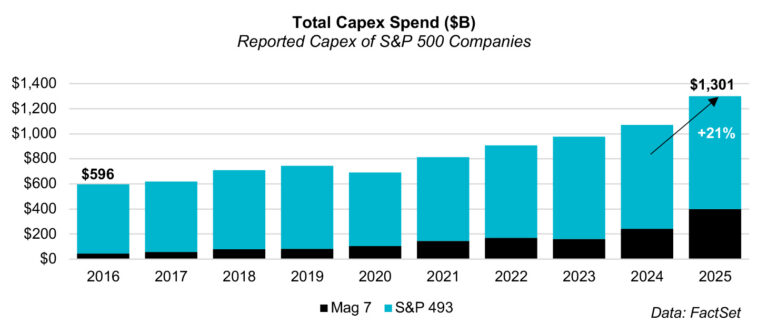
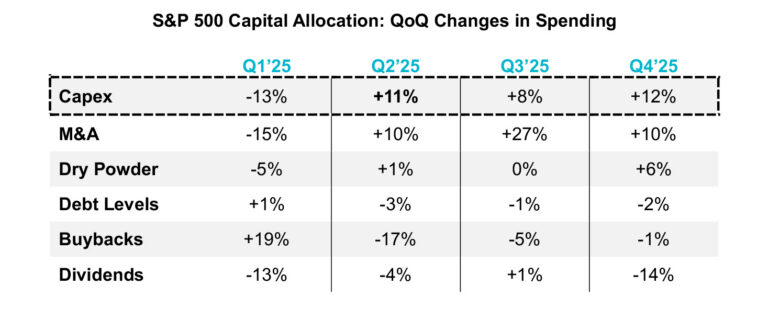
Compared to 2021, in which investments were initially focused on improving supply chain resilience, enhancing domestic manufacturing capacity, and expanding system infrastructure to meet the needs of the new work-from-home environment, the number of companies communicating an increase in capex spend since Q2’25 has been notable, with cited uses of AI, not surprisingly, driving significant increases, but also capacity and innovation.
Following the launch of ChatGPT in late 2022, which marked another inflection point in how companies approached capital deployment, AI has quickly moved from a long-term technology theme to an immediate strategic priority, prompting companies across sectors to evaluate infrastructure, computing capacity, and data investments. To that end, hyperscalers alone are expected to spend more than $500 billion on AI-related investments in 2026, making disciplined capital allocation and clear communication around investment priorities a growing focus for investors. At the same time, the growth momentum being experienced heading into 2026 has driven investor expectations for a more broad-based capex spend increase, as hope exists for those in rolling recessions to add to the pie. Indeed, in Q4’25, all but Consumer Staples and Materials saw year-over-year capex increases.
Still, while the momentum seems structural, the ongoing war in Iran, the rise in oil prices, and continued uncertainty make for a dynamic capex backdrop. And nothing can arrest investment like heightened uncertainty can. Notwithstanding significant negative developments in the Iran war, we believe the current growth capex trends we’re seeing have staying power, and clients should be prepared to harness the changing tide.
With that backdrop, we explore how to effectively communicate the nuances of capex, identify what investors focus on, avoid unforced errors, and outline best practices that we’ve identified as key differentiators.
Where Companies Go Wrong –
According to the Buy Side
Drawing on more than 28,000 interviews conducted over the past 18 years, our research shows that while investors broadly recognize the strategic importance of capital expenditures, their concerns center around several recurring themes:
Prolonged Elevated Spending
Capex remaining elevated for longer than expected, raising questions about capital intensity and free cash flow generation
“Capex has been elevated…They cannot spend this percentage of revenues for an unlimited period of time.”
“I have some concern that we are never actually going to see the ratio of capex to revenue decline again.”
“The expected level of strategic growth capex spend is too high…it creates concern over direction and management focus.”
Returns and Capital Discipline
Investors generally support higher investment when the return profile is clear, but remain focused on ensuring that capital is deployed with discipline
“If they are confident they are going to earn a return on the capital, then they should invest it…however, they need to make sure that return is there.”
“They are spending more on capex than I had been expecting 6 to 9 months ago, so then you have to achieve the targets and want to be able to show the returns it is generating. Capex is higher than peers. It is fair to say they are creating heightened expectations.”
Unanticipated Changes
When capex increases beyond prior expectations, investors often question planning discipline and closely evaluate whether the pace and magnitude of spending remain aligned with the company’s strategy and capital allocation framework
“If it is to increase capacity, this could lead to overcapacity three to five years out for the whole industry.”
“The new level of strategic growth capex spend is too high. They are spending a lot of capex relative to their debt and equity for a given number of years. It creates some concern over direction…it can be a little scary.”
“It is about magnitude. The capex is going up and up. Why do you need to increase this high if growth isn’t there?”
Unclear Strategic Rationale
Investors look for a clear connection between capex, strategic priorities, and expected returns; without it, confidence in the investment program can weaken
“One thing that does not come through in any of the investor communication is that you are putting hundreds of millions into efficiencies, and margins are not moving much. Where is that money going? What is capex being spent on? What are the returns on the capex? It comes forward nowhere in the presentation.”
“There could be more visibility. Tying in the increased level of capex closer to some of the initiatives it is being spent on, and giving people a sense of whether the increased capex level is the new norm.”
“How do we understand as investors where the dollars are really being spent? What is the time period you are forecasting for the opportunity?”
“They spend capex at a higher rate than peers, and it is not clear why they need to. The money spent on the network is well above what maintenance capital would be.”
“The decarbonization strategy and capex need clarification. Whether the assets are well invested and what will be the capex to reduce the carbon footprint is something that needs clarification.”
If there is one enduring message, it is this: companies create more value when they communicate changes proactively and transparently. Not even best-in-class companies are immune to exogenous forces that affect input costs or demand expectations after capex plans have been announced. Maintaining investor confidence during periods of elevated investment requires disciplined communication that clearly explains what has changed, why the strategy is evolving, and how the revised plan supports long-term value creation.
Maintaining Trust When Communicating Capex Plans
The current capex environment, shaped by a period of broad-based cost-cutting and expense management that began in mid-2022, contrasts with the now-heightened appetite for growth reinvestment and M&A among both investors and companies. This creates understandable tension for management teams and IR leaders alike. Companies are being asked to communicate long-term capital commitments with clarity at a time when conditions remain fluid.
The challenge, therefore, is not simply setting expectations but maintaining transparency and credibility when plans evolve. So, how can companies transparently communicate capex plans and updates amid a “certainly uncertain” backdrop? If you must update your outlook, what is the best approach, and how do best-in-class companies do so?
Announcing a Capex Plan
- Anchor Capex within the Capital Allocation Framework: Investors do not evaluate capex in isolation. The announcement should clearly position capex within the company’s broader capital allocation priorities, including debt reduction, shareholder returns, and M&A. Best practice is to explain where growth capex sits in the priority stack and how it fits within the long-term capital deployment strategy.
- Strike a Balance Between Disclosure and Safeguarding Competitive Information: Unlike M&A, capex can give away important competitive information to peer companies. Best practice is to strike a balance that provides enough disclosure to satisfy the investment community without sacrificing proprietary insight.
- Articulate Strategic Rationale Tied to Returns: Investors want to know what problem the investment solves or what opportunity it creates. Best practice is to tie capex directly to strategic objectives, including capacity expansion, technology modernization, supply chain resilience, and new market opportunities.
- Set Expectations for Duration and Normalization: Elevated capex often raises concerns about structural increases in capital intensity. Best practice is to provide visibility into the duration of elevated spending when capex is expected to normalize, and how capex may trend as a percentage of revenue over time. Also consider the importance of providing funding sources.
Announcing an Update
- Signal Changes Early: Investors consistently note that the most effective teams signal changes ahead of time so that formal guidance changes do not shock the market. Leverage earnings calls or other Reg FD-compliant channels to broadly lay the breadcrumbs to reduce the risk of surprises.
- Link Changes to Strategy and Returns: Again, link back to the capital deployment framework and provide appropriate context around:
- Growth Opportunity: If an explicit quantitative outlook is not provided, address how the change to capex influences the company’s growth trajectory.
- Clarify Operational Implications: Changes in capex can alter capacity assumptions and productivity expectations. When adjustments occur, companies should be prepared to explain how the change affects operations, including potential impacts on throughput, efficiency, or growth.
- Expected Returns: Investors are not inherently against capex, but they are against undisciplined investment. Changes to capex should be framed either in terms of incremental returns or as a percentage of revenue.
- Depreciation: Large increase to capex implies a coinciding increase in depreciation and subsequently lower earnings. Understanding how investors will work backward from an announcement to identify second- and third-order derivatives is a critical element in anticipating questions and concerns from the Street.
- Explain the Drivers of the Change Clearly: Provide clarity on the specific factors influencing the change, and what it means for operations, growth, and returns, which helps maintain investor understanding and confidence
- Highlight Discrete Items: When expectations shift due to one-off events, whether within or outside of management’s control, investors expect those factors to be clearly identified. Companies should specify whether the change reflects a temporary timing issue, a true one-time event, or a more structural shift in the business.
- Clarify AI Investment Discipline: As AI-driven capex accelerates, investors expect companies to clearly explain how these investments support long-term strategy, what infrastructure or capabilities they enable, and how returns will be measured over time. This starts with a well-defined AI strategy, which, in our experience, many companies lack.

Capex has remained at the center of investor scrutiny as investment cycles expand in reshoring, AI infrastructure, and long-term capacity growth. Investors are not opposed to elevated capex, but they expect investments to be disciplined, strategically grounded, and clearly communicated within a broader capital allocation framework. When companies fail to provide clarity around the rationale, returns, and/or duration of spending, confidence and buy-in can quickly erode, even when the underlying strategy is sound. In today’s environment of large, multi-year investment commitments, many of which investors do not have direct experience with, transparent, educational, and structured communication around capex is essential to sustaining investor trust and credibility with the Street.
- Capex Must Be Anchored in a Capital Allocation Framework: Investors evaluate capex alongside debt reduction, shareholder returns, and M&A, not in isolation
- Strategic Clarity and Return Expectations Matter Most: The Street expects companies to explain what the investment enables, how returns will be measured, and when spending may normalize
- Elevated Spending Increases Communication Expectations: As capex grows, particularly around AI and infrastructure, investors demand greater transparency and consistency
- Surprises and Unclear Rationale Create Skepticism: Unexpected increases or poorly explained spending can raise questions about discipline and planning
- Proactive Communication Builds Credibility: Companies that signal changes early, clearly explain drivers, and connect capex to long-term strategy build and maintain stronger investor confidence over time.
In Closing
In today’s environment of elevated and evolving capital investment, companies must communicate capex plans with clarity, discipline, and strategic context. At Corbin, our work with leading global companies is grounded in nearly two decades of proprietary investor research and more than 28,000 interviews with the buy side and sell side. This perspective enables us to help companies understand how the Street interprets capital allocation decisions and where communication gaps can emerge.
By translating investor feedback into actionable communication strategies, we help companies ensure that capex, whether tied to AI or other technology infrastructure, reshoring, innovation, or other long-term growth initiatives, is understood as a disciplined investment aligned with long-term value creation.
Stay tuned for next week’s Thought Leadership when we Commence the Quarter – Q1’26 earnings season is nearly upon us!