
This Week in Earnings – Q4'25
Technology Sector Beat
Quite the week as the data and software sector grapples with the specter of AI and the market, in general, absorbs 2026 guides and digests evidence of increased spend after years of hunkering down and cost cutting. As money rotates and the market recalibrates, there emerges a unique opportunity to pull the buyback trigger if you’re outside of the window. Outside of the big secular trends, we see green shoots of growth in several new places, but resilience is likely to be gradual.
Our thought leadership this week addresses:
- Key Events this week
- Earnings Snap, covering the S&P 500 stats to date
- Spotlight on Technology in The Sector Beat
Key Events
January 2026 Senior Loan Officer Opinion Survey (SLOOS)
- Business lending conditions tightened, with banks reporting stricter standards for commercial and industrial loans across firm sizes, alongside stronger demand from large and middle-market firms. Commercial real estate standards were largely unchanged, though demand increased for most CRE categories excluding multifamily. (Source: Federal Reserve)
- Household lending conditions remained broadly stable, but demand weakened across most consumer categories, particularly residential real estate, auto, and other consumer loans. Banks expect lending standards to remain mostly unchanged in 2026, while demand improves, though credit quality concerns persist for nonprime auto and credit card borrowers. (Source: Federal Reserve)
- AI exposure is influencing credit decisions, with banks indicating a greater willingness to approve loans for firms expected to benefit from AI adoption, and reduced appetite for lending to firms adversely affected by higher AI exposure. (Source: Federal Reserve)
Employment
- The December JOLTS report showed job openings continued to decline, falling to 6.5M below the consensus estimate of 7.25M, marking the lowest level since September 2020. The job openings rate declined to 3.9% from 4.2%, with notable decreases in professional and business services, retail trade, and finance and insurance. (Source: BLS, WSJ)
- January ADP Employment Report showed private-sector payrolls increased by 22K (+4.5% YoY), below the consensus estimate of +40K. ADP Chief Economist Nela Richardson noted that job growth slowed sharply in 2025, with 398K jobs added versus 771K in 2024, though wage growth has remained stable. Education and health services led gains, while job growth slowed in manufacturing, professional and business services, and large employers. (Source: ADP)
- The January Challenger report showed U.S.-based employers announced 108,453 job cuts, up 205% MoM and 118% YoY, marking the highest January total since 2009 and the largest monthly figure since October 2025. Challenger noted the elevated level suggests many layoffs were planned late in 2025, reflecting weaker employer confidence in the 2026 outlook. Job cuts were primarily driven by contract losses, market and economic conditions, and restructuring, while store and unit closures also contributed. AI accounted for 7% of January layoffs and has been cited in an increasing share of announced job cuts since tracking began in 2023. (Source: Challenger Report)
Policy to Post
- On February 4, President Trump spoke with President Xi of China: “I have just completed an excellent telephone conversation with President Xi, of China. It was a long and thorough call, where many important subjects were discussed, including Trade, Military, the April trip that I will be making to China (which I very much look forward to!), Taiwan, the War between Russia/Ukraine, the current situation with Iran, the purchase of Oil and Gas by China from the United States, the consideration by China of the purchase of additional Agricultural products including lifting the Soybean count to 20 Million Tons for the current season (They have committed to 25 Million Tons for next season!), Airplane engine deliveries, and numerous other subjects, all very positive!” (Source: Truth Social)
- On February 2, President Trump reached a trade agreement with Prime Minister Modi in a telephone call: “It was an Honor to speak with Prime Minister Modi, of India, this morning. He is one of my greatest friends and, a Powerful and Respected Leader of his Country. We spoke about many things, including Trade, and ending the War with Russia and Ukraine. He agreed to stop buying Russian Oil, and to buy much more from the United States and, potentially, Venezuela. This will help END THE WAR in Ukraine, which is taking place right now, with thousands of people dying each and every week! Out of friendship and respect for Prime Minister Modi and, as per his request, effective immediately, we agreed to a Trade Deal between the United States and India, whereby the United States will charge a reduced Reciprocal Tariff, lowering it from 25% to 18%. They will likewise move forward to reduce their Tariffs and Non Tariff Barriers against the United States, to ZERO. The Prime Minister also committed to “BUY AMERICAN,” at a much higher level, in addition to over $500 BILLION DOLLARS of U.S. Energy, Technology, Agricultural, Coal, and many other products. Our amazing relationship with India will be even stronger going forward. Prime Minister Modi and I are two people that GET THINGS DONE, something that cannot be said for most. Thank you for your attention to this matter!” (Source: Truth Social)
Earnings Snap
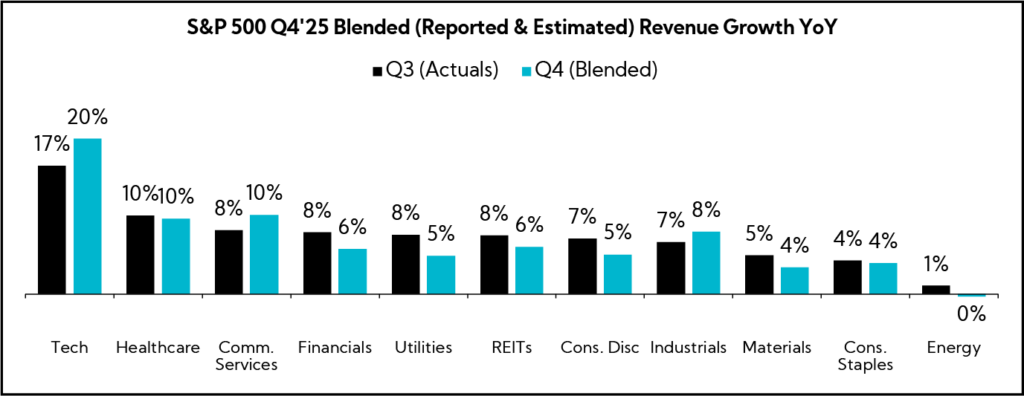
59% of the S&P 500 has reported earnings to date
Q4'25 Revenue Performance
- 72% have reported a positive revenue surprise, slightly above the 1- and 5-year averages of 71% and 70%, respectively
- Blended revenue growth (combines actual reported results for companies and estimated results for companies yet to report) is 8.2%
- Companies are reporting revenue 1.5% above consensus estimates, higher than 1-year average of 1.3% and lower than the 5-year average of 2.0%.
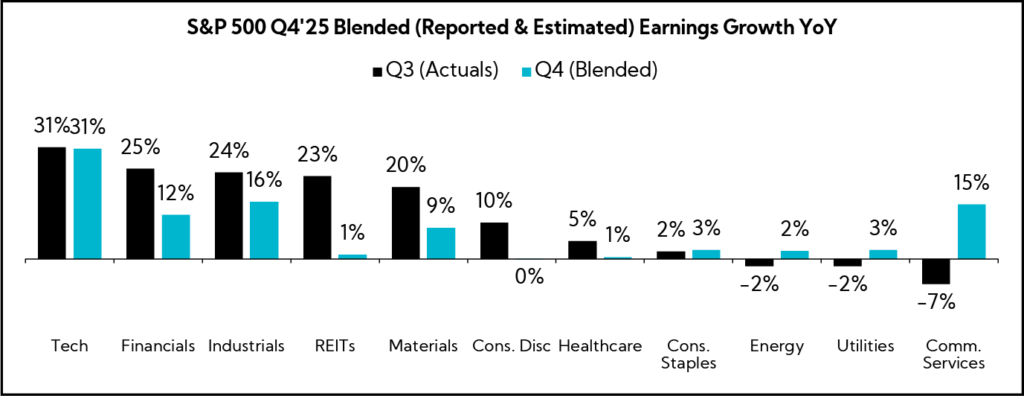
Q4’25 EPS Performance
- 77% have reported a positive EPS surprise, slightly below the 1- and 5-year averages of 78% and 79%, respectively
- Blended earnings growth (combines actual reported results for companies and estimated results for companies yet to report) is 13.5%
- Companies are reporting earnings 5.5% above consensus estimates, below the 1- and 5-year averages of 7.4% and 7.7%, respectively
The Sector Beat: Technology
Technology Guidance Trends
We analyzed annual revenue and EPS guidance for a basket of selected U.S. Technology companies with market caps >$1B that have reported to date.1 Below are our findings.
For comparison purposes, we provide an “All-Company” benchmark, which tracks in real-time a basket of calendar year companies larger than $1B in market cap across all sectors that have reported earnings to date (n = 168).
1 Calendar year reporters; as of February 5, 2026
Guidance Breakdown by Industry
| Industry | Number of Companies |
|---|---|
| Software | 9 |
| Electronic Equipment, Instruments & Components | 4 |
| IT Services | 1 |
| Total | 14 |
Source: Corbin Advisors
Annual Revenue and EPS Guidance
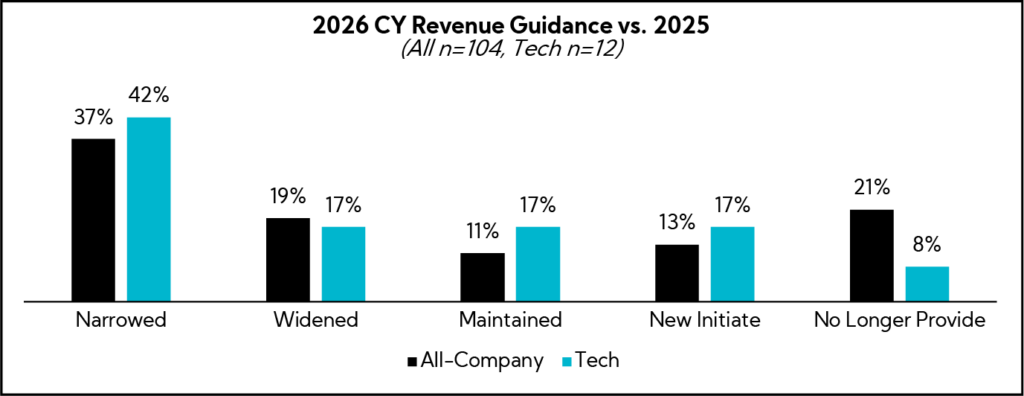
Revenue
42% of technology companies have Narrowed spreads relative to last year, slightly above the all-company benchmark (37%); 91% of outlooks are above 2025 actual results.
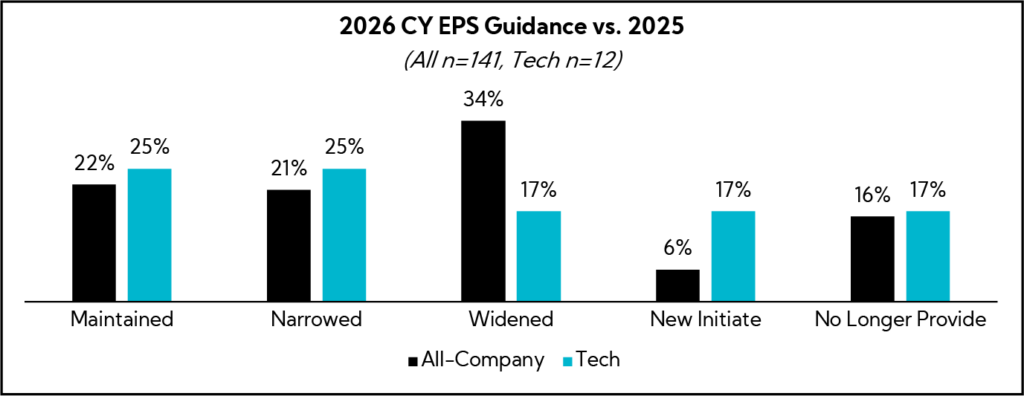
EPS
25% Narrowed spreads and 25% Maintained relative to last year, broadly in line with the all-company benchmark (22% and 21%, respectively); 17% Widened spreads, lower than the all-company benchmark of 34%. Most outlooks, 90%, are above 2025 actual results.
Earnings Call Analysis
We analyzed earnings calls across the Technology sector to identify key themes shaping the industry’s outlook.
Across the technology landscape, management commentary points to a macro environment marked by volatility but not weakness. While policy uncertainty, tariffs, and shifting government funding have weighed on certain end markets and elongated buying cycles in certain areas, demand tied to AI, semiconductors, cloud, and mission-critical infrastructure has remained resilient. Companies are increasingly prioritizing productivity, resilience, and scalability, treating these technologies as foundational platforms rather than discretionary tools. As a result, confidence in growth outlooks has improved, with multiple companies highlighting strengthening order trends and a more constructive setup heading into 2026.
Demand strength continues to outpace supply. Capacity constraints, longer lead times, and lean inventories are limiting near-term upside across semiconductors and AI infrastructure. Hyperscalers and hardware providers are operating in supply chase mode as AI-driven workloads accelerate faster than production can scale. While some companies are better positioned with inventory buffers, most expect supply, not demand, to remain the gating factor through at least the first half of 2026, reinforcing the need for sustained investment across the ecosystem.
AI remains the central secular driver. Companies are increasingly focused on embedding AI directly into workflows to unlock measurable business value. This transition is fueling a multiyear super cycle in AI infrastructure, networking, and high-performance compute, while elevating the role of services that translate infrastructure spending into ROI. AI is no longer confined to hyperscalers and is increasingly driving revenue mix, customer engagement, and strategic positioning for those well-positioned across hardware, software, and services. However, recent market activity has revealed a significant divergence between fundamental demand trends and investor sentiment toward certain software businesses, with a wave of investor anxiety over AI disruption triggering a steep selloff in software and data stocks. This reflects growing caution among investors about the long-term profitability of traditional software models amid technological transition, even as corporate demand fundamentals remain strong.
To support this unprecedented demand environment, companies are justifying elevated capex levels, prioritizing manufacturing capacity, R&D, and long-term growth while maintaining discipline around free cash flow. At the same time, workforce actions are being used strategically to boost productivity, realign skills toward higher-growth areas, and fund investment in innovation rather than serve as a blunt cost-cutting action.
Deal activity is also showing signs of acceleration, supported by clearer ROI cases. Regionally, growth remains strongest across Asia and emerging markets, Europe is stabilizing despite pricing pressure, and supply-chain diversification away from China continues to reshape global manufacturing and demand patterns.
Key Technology Earnings Themes
Macro and Outlook
Demand Tied to AI and Cloud Adoption Remain Resilient Despite Policy, Tariff, and Funding Volatility; Growth Outlooks Are Robust Heading into 2026
- IBM ($294.2B, IT Services): “We continue to operate in a dynamic environment, but one where client demand remains resilient in the categories that matter most to IBM. Enterprises are prioritizing technology investments that drive productivity, resilience and flexibility, particularly in hybrid cloud, AI, and mission-critical infrastructure. These technologies are no longer viewed as incremental tools, but as platforms that fundamentally change how businesses scale, compete, and operate.”
- Intel ($243.8B, Semiconductors & Semiconductor Equipment): “We’ve navigated a market that has shifted from tariff-driven uncertainty in the first half to an intense AI-driven demand environment constrained by supply in the 2H. The opportunity in front of us is meaningful and significant. The era of artificial intelligence is driving unprecedented demand for semiconductor across the entire compute landscapes from AI accelerated and traditional data centers into the network and enterprise domains all the way out to client and edge devices.”
- Gartner ($15.1B, IT Services): “2025 was a unique year. DOGE related initiatives affected our U.S. federal clients. Evolving trade policies created complexity for tariff-impacted enterprises. Funding changes affected our state and local government and education clients. Tech companies that are not in or adjacent to AI experienced a shifting landscape. And there were country-specific factors in several geographies. These external market forces led to increased scrutiny, elevated deal approval authority, and extended buying cycles. Over the past few years, including 2025, the rate of change and volatility in the external environment has increased significantly. Executives have responded to this by slowing and deferring everything possible. This makes for a much tougher selling environment.”
- CDW ($16.5B, Electronic Equipment, Instruments & Components): “2025 was a year that tested every part of our company. We managed through uncertainty around tariffs, unexpected shifts in education and health care funding, significant changes in government spending priorities and the longest federal government shutdown on record, factors that shaped customer buying behaviors in unconventional ways.”
- KLA ($184.9B, Semiconductors & Semiconductor Equipment): “The industry outlook for 2026 has strengthened over the past few months. Customer spending profile is expected to broaden across all major end markets. We are experiencing strong customer momentum that has accelerated over the past three months and is reflected in our system backlog and sales funnel. Our view today is that the 1H of 2026 revenue will grow MSD compared to the 2H of 2025, with accelerating growth in the 2H of the calendar year. Market environment and the complexity of our customers’ technology roadmaps are compelling, presenting both challenges and opportunities for KLA to maintain its relative outperformance.”
- TTM Technologies ($10.6B, Electronic Equipment, Instruments & Components): “From a demand standpoint, we expect healthy tailwinds due to our participation in two key megatrends currently driving economic growth: artificial intelligence and defense. ~80% of our net sales are related to these two megatrends.”
Supply Constraints
Elevated Demand Continues to Outpace Supply across Semiconductors, with Capacity Constraints, Rising Lead Times, and Lean Inventories Capping Near-term Upside as Companies Work to Expand Supply into 2026
- Microsoft ($3143.8B, Software): “Our customer demand continues to exceed our supply. Therefore, we must balance the need to have our incoming supply better meet growing Azure demand with expanding first-party AI usage across services like M365 Copilot and GitHub Copilot, increasing allocations to R&D teams to accelerate product innovation and continued replacement of end-of-life server and networking equipment.”
- Texas Instruments ($204.1B, Semiconductors & Semiconductor Equipment): “We are very pleased with the inventory position we have built. It’s across all of our technologies, at the right level. The inventory we have right now, that’s an asset that allows us to serve customers, especially in the current environment when we see a lot of real time, just in time demand. It allows us to support customers at a high level.”
- Intel ($243.8B, Semiconductors & Semiconductor Equipment): “Revenue, gross margin, and EPS were all above our guidance. We delivered these results despite supply constraints which meaningfully limited our ability to capture all of the strengths in our underwriting markets. We are working aggressively to address this and better support our customers’ needs going forward.”
- Apple ($3964.1B, Technology Hardware, Storage & Peripherals): “iPhone grew 23% and we exited the December quarter with very lean channel inventory due to that staggering level of demand. And based on that, we’re in a supply chase mode to meet the very high levels of customer demand. We’re currently constrained. And at this point, it’s difficult to predict when supply and demand will balance. The constraints that we have are driven by the availability of the advanced nodes that our SOCs are produced on. And at this time, we’re seeing less flexibility in supply chain than normal, partly because of our increased demand.”
- Rambus ($12.2B, Semiconductors & Semiconductor Equipment): “On the supply side, lead times continue to increase, and that’s why we believe in 2026, the demand is solid but we’re going to be more constrained by supplythan we’re going to be by demand.”
- Skyworks Solutions ($8.5B, Semiconductors & Semiconductor Equipment): “In general, the products that are being utilized, we are definitely at capacity. We are definitely hand-to-mouth from that. We’re scrambling to meet demands. And right now, our demand exceeds our supply. And so we’re continuing to work that.”
- KLA ($184.9B, Semiconductors & Semiconductor Equipment): “Customer lead times for our products are increasing due to supply constraints, limiting 1H growth potential across many of our products.”
AI
Focus Continues to Shift Toward Embedding AI into Workflows to Unlock Scalable, Measurable Business Value, as Enterprise-wide, Multiyear “Super-Cycle” Investments Drive Unprecedented AI-Infrastructure and Semiconductor Demand
- TD Synnex ($13B, Electronic Equipment, Instruments & Components): “During Q4, we announced AI Game Plan, the new customer-led workshop experience designed to help their sales teams translate AI opportunities into real world business outcomes for their end customers. We are just at the beginning and we’ll continue turning our vast data lake and algorithms into industry-leading scalable digital services, but enhance experiences, lower costs, and unlock new revenue and efficiency opportunities for our existing customers.”
- Intel ($243.8B, Semiconductors & Semiconductor Equipment): “The era of artificial intelligence is driving unprecedented demand for semiconductors across the entire compute landscapes from AI accelerated and traditional data centers into the network and enterprise domains all the way out to client and edge devices.”
- F5 ($15.9B, Communications Equipment): “AI-related investment is scaling as enterprises prepare for increased network capacity and services to support AI workloads, agentic AI, and inferencing demands. The resulting AI-related demand is fueling growth across our portfolio. AI is fundamentally transforming application behavior.”
- ServiceNow ($123.4B, Software): “The speculation of AI will eat software companies is out there. Let’s clear it up with the facts. Enterprise AI will be the largest driver of return on a multitrillion-dollar super cycle of investment in AI infrastructure. The real payoff comes when trillions of tokens move beyond pilots to be embedded directly into the workflows where business decisions are made. ServiceNow is the gateway to this shift, serving as the semantic layer that makes AI ubiquitous in the enterprise. You need AI plus workflows because AI is probabilistic, which by definition means we can’t be certain about the results. Workflow orchestration is deterministic, predictable, no randomness, which is required given the sophistication in governance of running global enterprises. AI doesn’t replace enterprise orchestration. It depends on it. It depends on governance. It depends on scale.”
- Advanced Micro Devices ($400.9B, Semiconductors & Semiconductor Equipment): “We are entering a multiyear demand super cycle for high-performance and AI computing that is creating significant growth opportunities across each of our businesses.”
- Cognizant Technology Solutions ($40B, IT Services): “As we enter 2026, our strategy is focused on solving the AI velocity gap, the gap between massive AI infrastructure spending in the past few years and business value realization for our clients. While AI technology is now mature enough to offer transformative value, the methodologies and tools to harness it are only just emerging and the value to enterprises hasn’t drifted yet. Our latest New World Research, reveals that AI today is capable of unlocking $4.5 trillion in U.S. labor value in the future. Cognizant’s mission is to be the AI builder, bridging this gap to enterprise value by converting the technology to measurable returns on investments for our clients.”
- Teradyne ($39.1B, Semiconductors & Semiconductor Equipment): “A striking trend was the increase in AI-driven revenue in the second half of 2025. AI demand drove 40% to 50% of our revenue in Q3. In Q4, AI drove more than 60% of our revenue. Looking forward to Q1 of 2026, we expect that upwards of 70% of our revenue will be driven by AI applications.”
Capex
Executives Connect Elevated Capex to Supporting Customer Demand, Prioritizing Manufacturing Capacity, R&D, and Long-term Growth Potential
- TE Connectivity ($66.6B, Electronic Equipment, Instruments & Components): “We are increasing our capex this year to support the growing pipeline of customer awards for AI programs. We now expect capex to be closer to 6% of our sales this year, and we feel strong about our cash generation model and continue to expect at least 100% free cash flow conversion for fiscal 2026.”
- Intel ($243.8B, Semiconductors & Semiconductor Equipment): “As we think about our capex for 2026, we’re working to balance our ability to drive capital efficiencies with our need to respond to the demand signals we’re receiving. Previously, we said capex would be down, but are now planning for a range of flat to down slightly, and for expenditures to be more weighted to the 1H. Capex in 2026 would be to support demand in 2027 and beyond. We expect to generate positive adj. FCF for the full year.”
- Enphase Energy ($4.8B, Semiconductors & Semiconductor Equipment): “Capex was $9.7M for Q4 compared to $8M for Q3. This increase was primarily due to continued investment in our U.S. manufacturing and R&D equipment.”
- Lumentum Holdings ($30B, Communications Equipment): “This quarter our cash and short-term investments increased by $33M to $1.16B. Our inventory levels increased by $39M sequentially to support the expected growth in our cloud and AI revenue. This quarter, we spent $84M in capex, primarily focused on manufacturing capacity to support cloud and AI customers.”
- Benchmark Electronics ($1.9B, Electronic Equipment, Instruments & Components): “We also have some program wins that will require some capex within our current footprint. Typically, we say the 1.5% to 2% of capex for the year. This may be 2% to 2.5%, as you think about this year.”
- Lam Research ($296.6B, Semiconductors & Semiconductor Equipment): “Capex for the December quarter was $261M, which was up $76M from the September quarter. Spending was driven by investments in manufacturing capacity, R&D and lab infrastructure that supports our technology roadmap and customer needs. We also purchased a new building in Arizona to support the growing industry footprint there. Looking forward, we continue to expect capital expenditure to be in the 4% to 5% of revenue range.”
- Teledyne Technologies ($28.8B, Electronic Equipment, Instruments & Components): “We’ve never paid a dividend and we’re more concerned about investing. Just last year, we increased our capex by 40%, and we increased our R&D spending by 10%.If we can’t find really good acquisitions, even though last year was a good year for acquisitions, we invest in capex and R&D, and we’re going to do that moving forward.”
- Amphenol ($177.4B, Electronic Equipment, Instruments & Components): “From a capital perspective, we were certainly spending at a bit higher level but honestly, with the growth we have seen, we ended the year with a bit over 4%. 3% to 4% is our historic range. As we go into 2026 and we continue to see opportunities for growth and certainly we’ve had these strong orders here we talked about in Q4, we expect that capital spending to still be certainly at that upper end of that 4% range.“
Workforce Reductions
Companies are Strategically Announcing Headcount Reductions to Boost Productivity, Align Skills with Higher-growth Priorities, and Protect Margins, Freeing up Resources for Reinvestment in Innovation Rather than a Pure Cost-cutting Measure
- Viavi Solutions ($5.9B, Communications Equipment): “Last week, we approved a restructuring and workforce reduction plan to improve operational efficiencies and better align workforce and resources with our current business needs and strategic priorities. We expect ~5% of our global workforce to be impacted, and estimated to incur ~$32M of restructuring charges in connection with this plan. Upon completion of this initiative, we expect annual savings of about $30M, which will mainly benefit our operating expenses. We intend to reinvest a portion of these savings with higher growth areas of our business. We expect to recognize majority of these charges by the end of June 2026, with the plan to be substantially completed by the end of December 2026.”
- Gartner ($14.6B, IT Services): “In any transformation, you find that you have people that don’t have the skills today that you need going forward. For those people, we unfortunately we had an action that we took so that we could reposition the skills so we have the skills we need going forward, not the skills we need in the past. So it had nothing to do with cost, it had to do with making sure we had the skills to address the impact, volume, timeliness, and user experience that we need as a business to thrive in any economic environment.”
- Intel ($243.8B, Semiconductors & Semiconductor Equipment): “Over the last 10 months, we established the foundation for new Intel, a more focused and execution-driven company. We simplified our organization and greatly reduced bureaucracy to improve efficiency and accelerate decision-making. We also recruited new leaders from the outside and empowered key leaders from within.”
- DXC Technology ($2.6B, IT Services): “Our headcount reductions have kept pace with the revenue profile of the company. I’d describe AI as an enabler to let us continue that good profile and discipline management. And we see that accelerating in the future, not slowing down, specifically because of AI.”
- Enphase Energy ($4.8B, Semiconductors & Semiconductor Equipment): “As part of our efforts to better align our workforce and cost structure with Enphase’s business needs, strategic priorities, and ongoing commitment to profitable growth, we recently reduced head count by around 6%. We expect to reduce our non-GAAP operating expenses to be in the range of $70M to $75M a quarter, starting from…Q3.”
- FormFactor ($5.5B, Semiconductors & Semiconductor Equipment): “Over the past two quarters, we have taken several actions, including: first, reducing and reallocating our workforce, and more effectively deploying those resources even as we execute on record-level demand; second, driving improvement in manufacturing yields in key process areas; third, innovating to reduce manufacturing spending; and finally, reducing cycle times in our key manufacturing operations. “
Deal Activity
Companies See Signs of Acceleration with Strong ROI Cases Supporting a Healthier Pipeline and a More Active M&A Environment Heading into 2026
- Roper Technologies ($39.6B, Software): “Regarding M&A opportunities, we’ve been proactive and successful in executing high-quality acquisitions for the last couple of years despite a weak M&A market. Most anticipate the market to pick up in 2026.”
- DXC Technology ($2.6B, IT Services): “We’re getting a lot of opportunities that are driven by corporate spin-outs, restructurings and breakups. We have existing customers and new customers that are going through the business rationale and then the actual execution of those spin-outs. Those spin-outs require a tremendous amount of support from a system standpoint, and we are getting a good amount of opportunities, both existing clients and new clients. That is a step-up that is reflected by the macro environment where it’s easier now to potentially do deals and get things approved in various governments around the world.”
- Dolby Laboratories ($6.2B, Software): “The deals are coming in earlier than expected. It does de-risk our pipeline for the full year and gives us a little more confidence about our ability to execute for the rest of the year.”
- ServiceNow ($123.4B, Software): “What’s so cool about this buying cycle is if you have an ROI and you’re fast to value, you don’t actually need a budget to get approval on your deal. You just need an executive that wants to win and the CEOs are investing heavily. Our pipelines have never been better.”
- Crane NXT ($10.7B, Electronic Equipment, Instruments & Components): “M&A activity is robust and we continue to execute and cultivate accelerated opportunities. We see many opportunities progressing through 2026, but at this time, nothing additional is imminent in Q1. “
Around the World
Strong Growth across Asia and Emerging Markets, with Europe Showing Signs of Recovery Despite Pricing Pressure; OEMs Continue to Diversify Supply Chains Away from China to Other Low-cost Manufacturing Regions
- Enphase Energy ($4.8B, Semiconductors & Semiconductor Equipment): “Across Europe, competition remains intense and pricing pressure is high as installers adapt to a tougher demand environment. We are responding by controlling costs within our current products and aligning pricing to market realities.”
- Avnet ($5.2B, Electronic Equipment, Instruments & Components): “In Asia, sales reached a record high of over $3B. This marks our sixth consecutive quarter of YoY sales growth in the region. Demand increased across most of the verticals and geographies we serve for both the YoY and sequential compares. In EMEA, we’re seeing clear signs of recovery with sales growing both sequentially and year-on-year. Most end markets showed YoY growth, including industrial; while compute, consumer, and transportation were the strongest end markets We are encouraged with the improving outlook in the region, especially given the continued market uncertainty.”
- Extreme Networks ($2B, Communications Equipment): “The strength of our funnel reflects a robust demand environment across all our industry verticals with double-digit pipeline growth in state, local and education and continued momentum across manufacturing, healthcare and general enterprise. On top of these dynamics, a return of government spending in Europe, expansion in APAC and continued momentum in Americas underpin these trends.”
- ServiceNow ($123.4B, Software): “The public sector more broadly is growing, not just U.S. Fed, but also state and local. And we shouldn’t forget the global government business because that was up 80% YoY. So, the global government business is on fire across Europe, Middle East, and obviously Asia.”
- TD Synnex ($13B, Electronic Equipment, Instruments & Components): “Europe grew faster than we anticipated as customers prioritized infrastructure software, PC device upgrades, and modernization of aging infrastructure, despite the slower macroeconomic backdrop. As we’ve seen over the last few quarters, Asia Pacific and Japan remain a key growth engine, driven by rapid cloud expansion, PC device upgrades, accelerating AI development, and strong demand from fast, digitizing economies across the region. Our growth story in Latin America remains encouraging, delivering double-digit top line momentum with strong engagement across our portfolio and customer base.”
- Lam Research ($296.6B, Semiconductors & Semiconductor Equipment): “China came in at 35%, which was a decrease from the prior quarter level of 43%, but slightly higher than our original expectations. This was due to updates in the affiliate rule and the resulting timing of shipments from that. The next largest geographic concentrations were Taiwan coming in at 20%, up sequentially from 19% and Korea at 20%, up sequentially from 15%. “
- OSI Systems ($4.2B, Electronic Equipment, Instruments & Components): “We are seeing growth across industries ranging from medical diagnostics to semiconductors driven by the breadth of our offerings. Optoelectronics and Manufacturing division also had a strong book-to-bill ratio this quarter. This division continues to see an expanding opportunity pipeline, as OEMs are active in diversifying away from China and de-risking their supply chains by shifting to other low-cost manufacturing regions. By expanding our production capacity with our newest manufacturing facility in Mexico and leveraging our operations across Southeast Asia, India and North America, we are poised to meet rising global demand and continue benefiting from this trend.”
In Closing
The Technology sector is navigating short-term complexity while positioning for multi-year growth. Despite ongoing macro volatility, policy uncertainty, and supply constraints, management teams are responding with confidence, prioritizing investment as demand tied to AI, cloud, and advanced semiconductors remain resilient. Supply limitations are increasingly viewed as a timing issue rather than a structural concern, reinforcing elevated capital investment and capacity expansion plans into 2026 and beyond. That said, investor sentiment toward certain software segments has soured in recent weeks, with software stocks experiencing notable selloffs amid fears that new AI tools could disrupt traditional software and data business models. This market reaction highlights a growing divergence between strong fundamental demand for AI-linked technology and investor expectations around future profitability in the broader software landscape.
At the same time, execution discipline remains a key theme across the sector. Elevated capex is being balanced with free cash flow focus, workforce actions are being used to realign skills and boost productivity rather than simply cut costs, and M&A activity is showing early signs of reacceleration where clear ROI and strategic fit exist.
As AI adoption progresses from infrastructure build-out to embedded, workflow-driven value creation, those well positioned within the Technology sector are preparing for a sustained growth cycle beyond 2026, even as sentiment dynamics around software valuations warrant attention.
Up next week: Consumer Discretionary in our Sector Beat.