
This Week in Earnings – Q4'25
Industrials Sector Beat
Our thought leadership this week addresses:
- Key Events this week
- Earnings Snap, covering the S&P 500 stats to date
- Spotlight on Industrials in The Sector Beat
Key Events
Monetary Policy
- The Federal Reserve held the federal funds target range at 3.5%–3.75%, as widely expected by markets. The Fed noted that economic activity continues to expand at a solid pace, while job gains remain subdued and the unemployment rate shows signs of stabilization. Inflation remains somewhat elevated, and the Committee reiterated its commitment to achieving maximum employment and 2% inflation over the longer run, while remaining attentive to elevated uncertainty and risks to both sides of its dual mandate (Source: The Federal Reserve)
- The Bank of Canada today held its target for the overnight rate at 2.25%, with the Bank Rate at 2.5% and the deposit rate at 2.20%. According to its Monetary Policy Report, U.S. tariffs and uncertainty around future trade arrangements continue to disrupt the Canadian economy, contributing to modest growth as firms adjust supply chains and reallocate capital and labor. While economic growth is expected to remain subdued through the transition, inflation remains close to the 2% target, even as elevated global fragmentation, geopolitical risks, and uncertainty around North American trade weigh on the outlook. (Source: Bank of Canada)
Consumer Confidence
- The Conference Board Consumer Confidence Index declined sharply in January, falling 9.7 points to 84.5 following a brief improvement in December. Dana M. Peterson, Chief Economist at The Conference Board, noted that all five components deteriorated, pushing the Index to its lowest level since May 2014 and below its lows reached during the COVID-19 pandemic. (Source: The Conference Board)
Employment
- U.S. initial jobless claims decreased 1,000 to a seasonally adjusted 209K for the week ended January 24, above economist forecast of 205K. Continuing claims fell to 1.83M in the week ended January 29, the lowest since September 2024. (Source: Labor Department, Bloomberg)
- While overall layoff levels remain relatively low, several large employers, including Amazon and UPS, have recently announced additional job cuts on top of earlier reductions in 2025. Layoffs have broadened across sectors, with companies citing higher operating costs driven by new tariffs, persistent inflation, and shifting consumer spending patterns. Some firms continue to scale back workforces following pandemic-era hiring surges, particularly in e-commerce, while others are reducing headcount as capital is reallocated toward AI as part of broader corporate restructuring efforts. (Source: AP News, Bloomberg, The Wall Street Journal)
Policy by Post
- Today, President Trump nominated Kevin Warsh as next Fed chair: “I am pleased to announce that I am nominating Kevin Warsh to be the CHAIRMAN OF THE BOARD OF GOVERNORS OF THE FEDERAL RESERVE SYSTEM. Kevin currently serves as the Shepard Family Distinguished Visiting Fellow in Economics at the Hoover Institution, and Lecturer at the Stanford Graduate School of Business. He is a Partner of Stanley Druckenmiller at Duquesne Family Office LLC. I have known Kevin for a long period of time, and have no doubt that he will go down as one of the GREAT Fed Chairmen, maybe the best. On top of everything else, he is “central casting,” and he will never let you down. Congratulations Kevin!” (Source: Truth Social)
- On January 26, President Trump provided an update regarding Minnesota: “Governor Tim Walz called me with the request to work together with respect to Minnesota. It was a very good call, and we, actually, seemed to be on a similar wavelength. I told Governor Walz that I would have Tom Homan call him, and that what we are looking for are any and all Criminals that they have in their possession. The Governor, very respectfully, understood that, and I will be speaking to him in the near future. He was happy that Tom Homan was going to Minnesota, and so am I! We have had such tremendous SUCCESS in Washington, D.C., Memphis, Tennessee, and New Orleans, Louisiana, and virtually every other place that we have “touched” and, even in Minnesota, Crime is way down, but both Governor Walz and I want to make it better!” (Source: Truth Social)
Earnings Snap
33% of the S&P 500 has reported earnings to date
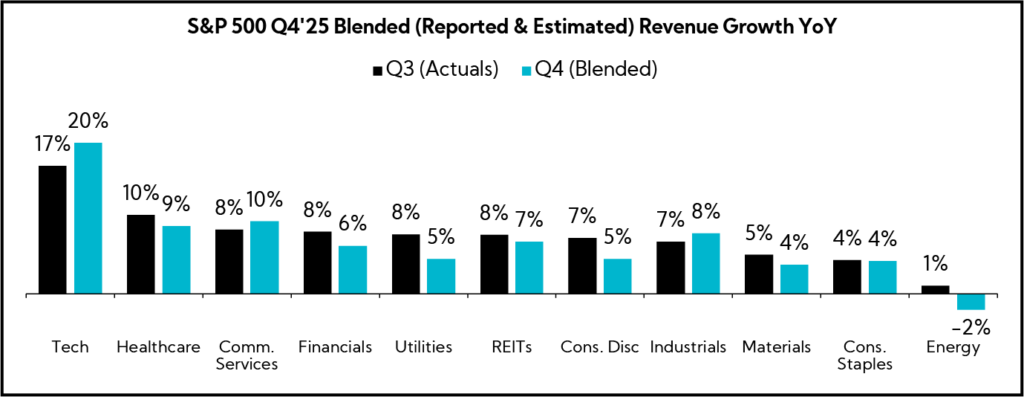
Q4'25 Revenue Performance
- 66% have reported a positive revenue surprise, below with the 1- and 5-year averages of 71% and 70%, respectively
- Blended revenue growth (combines actual reported results for companies and estimated results for companies yet to report) is 7.7%
- Companies are reporting revenue 1.4% above consensus estimates, below with the 1-and 5-year averages of average 1.3% and the 2.0%, respectively
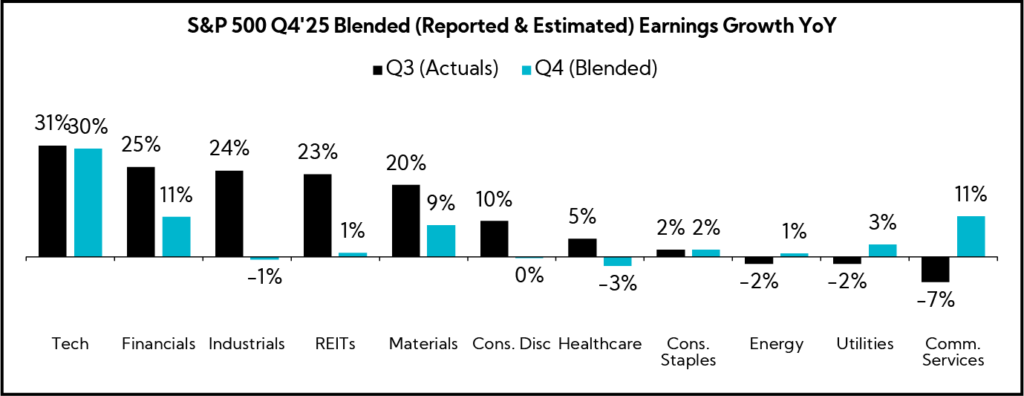
Q4’25 EPS Performance
- 77% have reported a positive EPS surprise, slightly below the 1- and 5-year averages of 78% and 79%, respectively
- Blended earnings growth (combines actual reported results for companies and estimated results for companies yet to report) is 10.9%
- Companies are reporting earnings 5.9% above consensus estimates, below the 1- and 5-year averages of 7.4% and 7.7%, respectively
The Sector Beat: Industrials
Industrial Guidance: Initial Trends
At the beginning of each year, we analyze annual revenue and EPS guidance spreads provided by calendar year Industrial companies with market caps greater than $1B that have reported to date.1 Below are our findings.
1 As of 1/29/26
Guidance Breakdown by Industry
| Industry | Number of Companies |
|---|---|
| Aerospace & Defense | 7 |
| Machinery | 4 |
| Passenger Airlines | 3 |
| Building Products | 3 |
| Commercial Services & Supplies | 2 |
| Industrial Conglomerates | 2 |
| Air Freight & Logistics | 1 |
| Trading Companies & Distributors | 1 |
| Total | 23 |
Source: Corbin Advisors
Revenue Guidance
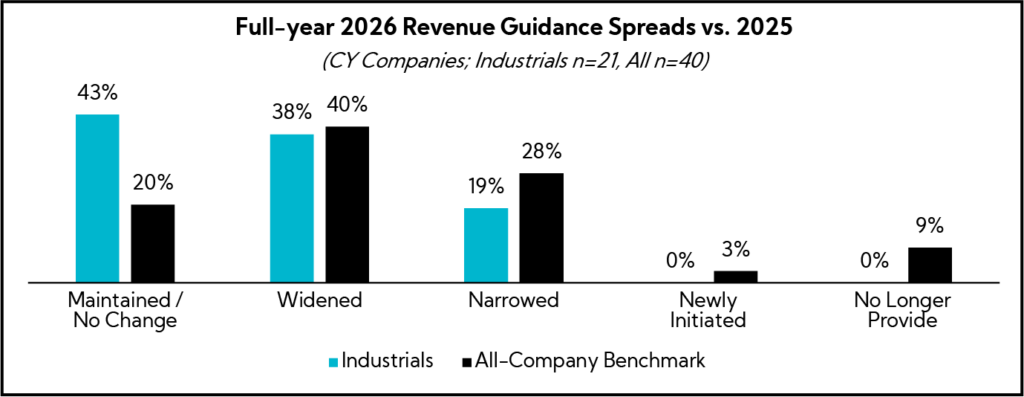
To date, 43% of Industrials have maintained initial annual revenue guidance spreads in line with last year’s spreads, while 38% Widened and 19% Narrowed. Spreads average 180 bps, compared to 153 bps last year.
Guidance midpoints average 5.1% growth, and 86% of outlooks are above 2025 actuals. As a reminder, according to our recent Inside The Buy-Side® Industrial Sentiment Survey® , 55% of investors are expecting 2026 annual industrial organic growth guidance to be higher than 2025 actuals heading into earnings season.
Annual Revenue Guidance Summary
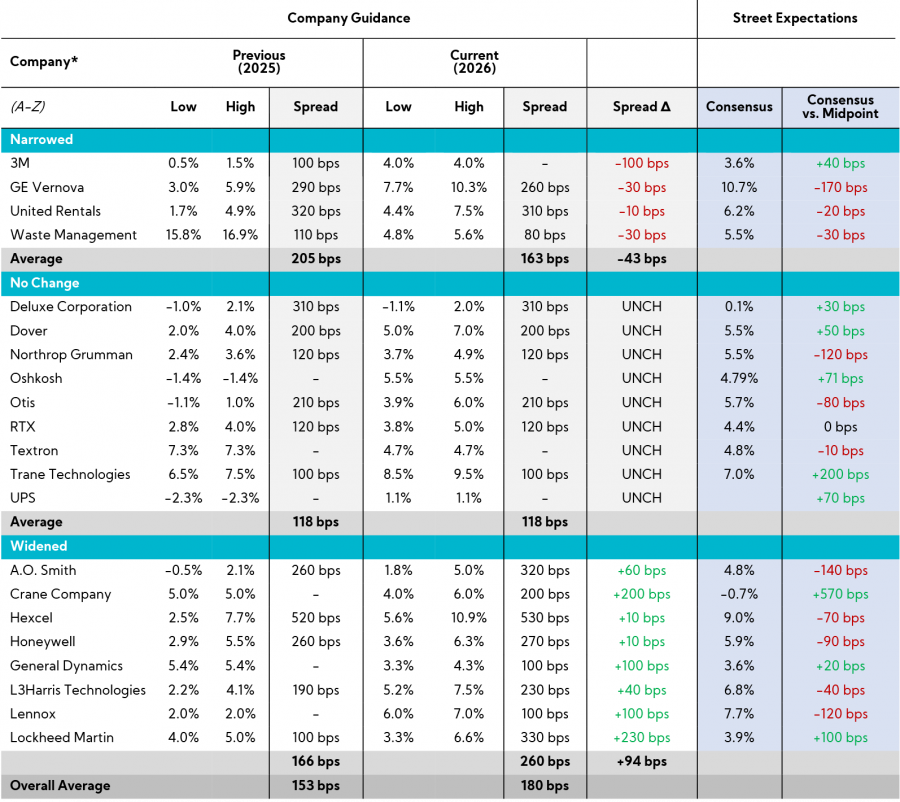
*AAL, ALK, DAL, GE, and UAL do not provide revenue guidance
EPS Guidance
Half of Industrial companies maintained initial annual EPS spreads in line with 2025, while the remaining 45% is split between Narrowed and Widened. Spreads average $0.49, compared to $0.43 in 2025.
Most outlooks, 84%, are above 2025 actuals. According to investors that participated in our Inside The Buy-Side® Industrial Sentiment Survey® , 55% were expecting 2026 annual industrial EPS guides to be higher than 2025 actuals.
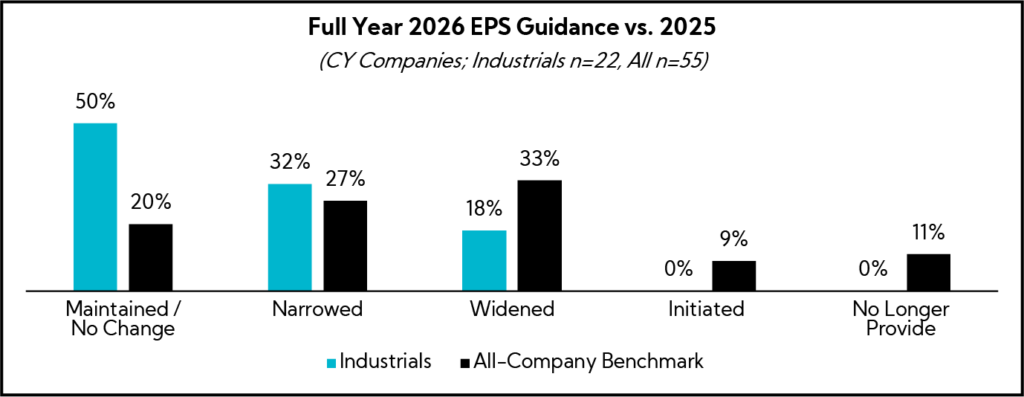
Annual Adj. EPS Guidance Summary
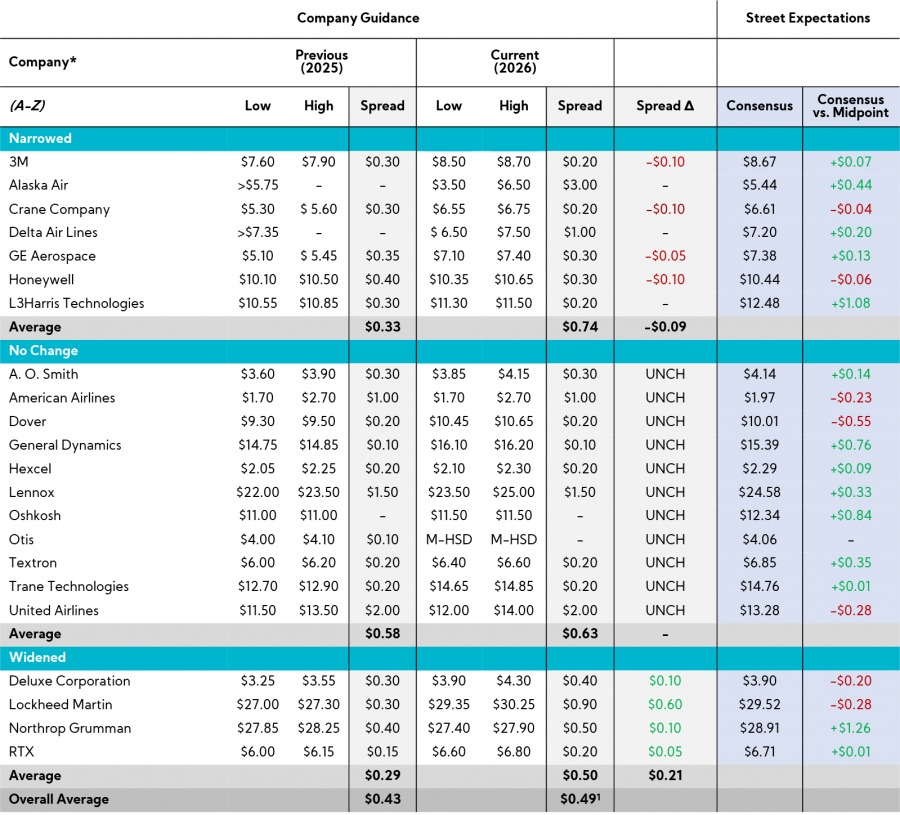
* GEV, UPS, URI and WM does not provide EPS guidance
1 Excludes AAL and DAL
Industrial Earnings Call Analysis
We also analyzed the earnings calls for this group and the broader Industrial universe to identify key themes.
Industrial company commentary points to a cautiously constructive outlook heading into 2026, with demand holding up well in structurally supported end markets despite a mixed macro backdrop. Aerospace and defense remain clear demand leaders, supported by elevated backlogs, rising global defense budgets, and continued strength in commercial air travel, particularly at the premium level. Data center-driven power and electrical equipment demand is another standout, and companies are hopeful that transportation markets are beginning to show signs of improvement as tightening capacity could begin to support gradual recovery. Outside of these areas, industrial and residential end markets are seeing spots of green, though private non-residential construction remains under pressure.
Despite tariffs remaining a headwind in certain areas, most industrial companies expect margin expansion in 2026. Management teams broadly indicate that tariff impacts are now largely embedded in guidance and increasingly mitigated through pricing actions, sourcing adjustments, and cost controls. Pricing power, especially in aerospace, defense, and energy infrastructure, continues to outpace inflation, while improving supply chains and operating leverage further supporting margin recovery.
Operational execution continues to be a central theme, with companies emphasizing simplification, productivity gains, and cross-functional integration as key enablers of consistent performance. Efforts range from streamlining manufacturing processes and reducing complexity to investing in automation, digitization, and AI-driven workflows. These initiatives are already translating into improved delivery performance, higher workforce productivity, and better alignment between commercial, engineering, and supply chain functions, positioning companies to scale more efficiently as demand strengthens.
Capital allocation reflects this longer-term confidence, with elevated but disciplined growth capex planned across the industrial landscape, consistent with findings from our Q4’25 Inside The Buy-Side® Industrial Sentiment Survey®, where most respondents expect capex to increase. Investments are being directed toward capacity expansion, technology upgrades, and innovation / next-gen platforms, often tied directly to existing backlog and customer demand, while maintaining a focus on cash flow and returns.
Geographically, growth remains uneven: North America, the Middle East, and select emerging markets are providing support, Europe remains sluggish, and China appears to be stabilizing off low levels rather than rebounding, reinforcing a global environment defined more by resilience and selectivity than broad-based acceleration.
Key Industrial Earnings Themes
Demand
Aerospace, Defense, and Data Center Demand Remain Strong; Transportation Sees Improvement; Select Green Shoots Emerge in General Industrial and Resi End Markets; and Pockets of Softness in Nonresi Persist
- Northrop Grumman ($96.4B, Aerospace & Defense): “Demand signals remained strong, and we anticipate continued growth in 2026 and beyond. The global appetite for our technology is fueling this demand, particularly in air and missile defense system, advanced munitions, radars, and a diverse array of airborne capabilities.”
- PACCAR ($63.4B, Machinery): “The truckload segment is beginning to accelerate, with industry customer demand and spot rates picking up in December. The 2026 U.S. and Canadian Class 8 truck market is forecast to be in a range of 230,000 to 270,000 vehicles as economic growth, regulatory and tariff clarity and improving freight conditions are poised to improve customer demand.”
- GE Vernova ($187.9B, Electrical Equipment): “In Q4, orders remained strong at roughly 2.5x revenue and increased 50% YoY due to growing great equipment demand, particularly for synchronous condensers, substations, partially to support data center growth and switchgear. We saw strong equipment orders growth in the Middle East and in North America, which more than doubled YoY.”
- RTX ($269.9B, Aerospace & Defense): “Demand remains strong, which combined with our existing backlog and focus on execution, positions us well for another year of top line growth. Commercial air travel is expected to grow again. The global RPK [revenue passenger kilometers] is projected to increase around 5% this year, on top of the 5% we saw in 2025.”
- Graco ($14.5B, Machinery): “There was a little bit of a pickup in the home center channel. Where that goes from here, none of us really knows, but that was encouraging to us because that has been a headwind for us for a number of quarters now. So hopefully, we’re starting to see some signs of life there. I think there’s a sense that at least here in North America, kind of a flattish outlook on residential housing. So, not any dramatic shift there, being held back a little by affordability. The team is pretty bullish about commercial opportunities really throughout the country, multifamily and some of the infrastructure things that are going on. And surprisingly, talking with some of the paint manufacturers, they’re actually starting to see some hope on residential repaint. As you know, the turnover in homes has been anemic the last couple of years. And to the extent that we get houses turning over again, there is a little bit more of a renewed bullishness on the residential repaint side.”
- Hexcel ($6.5B, Aerospace & Defense): “The current backlog for commercial aircraft has exceeded 17,000. Same report also noted that to date, there has been a delivery shortfall of at least 5,300 aircraft, underscoring the current imbalance between supply and demand for commercial aircraft. The fact that even with this historically high backlog, airlines are still ordering new aircraft underscores how much demand there is for these new aircraft. This situation is positive for manufacturers like Hexcel as production rates are likely to remain at elevated levels for an extended period.”
- Honeywell International ($140.3B, Industrial Conglomerates): “In 2026, we anticipate that the demand for our differentiated, high value solutions and continued pricing that is outpacing inflation will drive further margin expansion. We expect growth to be led by aerospace on higher commercial demand and increased defense budgets and building automation, driven by new product innovations. This will be partially offset by slower start to the year in process automation technology, which turns to growth in the second half, driven by order, visibility and significantly easier comps, and mixed regional and end market dynamics industrial automation.”
- Oshkosh ($9.5B, Machinery): “What we all hear about on a regular daily basis of what’s going on, really strong big mega projects and data centers, power gens, some large infrastructure projects, so that that does drive demand and that’s very positive. On the other hand, you’ve got private non-res construction, which is a huge segment of nonresidential construction which is still under some pressure.”
Margins, Tariffs & Pricing
While Tariffs Remain a Headwind for Some, Most Expect Margin Expansion in 2026 as Impacts on Margins Are Largely Offset by Pricing Actions, Cost Discipline, and Operational Efficiencies
- RTX ($269.9B, Aerospace & Defense): “We’re still living with the tariff situation. We do expect to see a bit of a tailwind, as we move from 2025 to 2026 on tariffs, probably about $75M lower. We’re picking up an extra quarter of tariff expense in 2026. So the first quarter will be a little bit depressed on the Collins margins as they pick up an extra quarter. But nonetheless, I’m still seeing really good margin expansion “
- Graco ($14.5B, Machinery): “The effects of our targeted interim pricing actions more than offset higher product costs resulting from lower factory volume, unfavorable effect of lower margin rates from acquired operations and incremental tariffs. Tariffs affected product costs by $4M in the quarter, resulting in a 70bps decline in the gross margin rate. For the full year, tariffs of $14 million had an unfavorable impact of 60 bps on the gross margin rate. And as we’re heading into 2026, we don’t expect headwinds. They’re baked into the numbers.”
- General Dynamics ($99B, Aerospace & Defense): “The impact of tariffs in 2025 was $41M. The tariffs that we are going to see in 2026 are largely based on cash that we expended in 2025. It will be higher than in 2025, so higher than the $41 million, but those tariffs are contemplated in our 2026 margins.”
- O. Smith ($9.8B, Building Products): “Other material and freight costs, including the carryover impact of tariffs, will also be a headwind in 2026. Our guidance assumes no change to the current tariff levels that are in effect today, but we continue to monitor the situation closely.”
- Honeywell International ($140.3B, Industrial Conglomerates): “Largely, tariffs are behind us. Going into 2026, price will be better for aerospace. And supply chain is continuing to improve. For 2026, it’s not a margin expansion question is really a question of how much. That’s a factor of mix, and how it’s going to play out in the business as well as how we continue to unlock and scale up, the supply chain and how the trajectory progresses. But 2026, I fully expect margin expansion in aerospace.”
- Oshkosh ($9.5B, Machinery): “Adjusted operating income margin of 8.8% reflected unfavorable price cost dynamics, including about $20M of tariffs and adverse product mix, partly offset by higher sales volume. Across all segments, the impact of tariffs was approximately $25 million. We try to minimize the impact to our customers. But you can’t eliminate all of it. So eventually you have to pass some through in price and we we’ve done that.”
- Caterpillar ($299B, Machinery): “Our adjusted operating profit margin expectation reflects the ongoing impact of tariffs, as well as investments we are making to execute our growth strategy. I remain confident that we’ll manage the impact of tariffs over time, as we aim to operate around the midpoint of our adjusted operating profit margin target range. The absolute dollar value of new tariffs imposed in 2025 was $1.8B. Mitigating actions can come in two forms, first of those that reduce the direct tariff exposure bill, which will include actions like sourcing changes. Second, there are cost control actions and pricing which help reduce the impact on our profitability. Most of the actions taken in 2025 related to cost controls, which could be specifically attributed to tariff mitigation, and these amounted to around $100M, resulting in a net incremental tariff impact of $1.7B.”
Operational Excellence
Prioritizing Simplification, Cross-functional Integration, Cost Controls, Productivity-focused Investments, and Technology to Improve Execution and Position for Growth
- Boeing ($191.5B, Aerospace & Defense): “We’ve simplified more than 5,100 work instruction documents. These are the instructions that the mechanics and inspectors use each day to do their jobs. These type of activities reduce complexity, support consistent performance, and strengthen factory health. On 737, production is stabilizing at 42 airplanes per month, and we’re continuing to see improvement in the program as its on-time delivery performance has improved threefold compared with the previous year.”
- GE Aerospace ($312B, Aerospace & Defense): “To further accelerate our progress in 2026, we are integrating our product line, engineering, and supply chain teams will improve our end-to-end engine lifecycle management. We’re also elevating our customer-facing teams, aligned with our customer-driven approach. These changes will enable greater cross-functional problem solving, agility, and alignment to deliver for our customers.”
- Lennox International ($17.5B, Building Products): “Since 2022, we have deployed an incremental $300M to broaden our capability, streamline our operation, and strengthen our competitive position. These investments are now embedded in how we run the business and are reflected in our financial statements. The benefits they unlock are only beginning to materialize and will continue to build as we move forward. We focus first on elevating front-end excellence to create a more efficient and responsive operating model. As part of this effort, we have expanded and reorganized our sales team to ensure alignment around pricing and improve coordination across the organization. This approach gives our teams clearer priorities and strengthens the connection between how we engage with customers and how we generate profitable growth.”
- Union Pacific ($137.9B, Ground Transportation): “Our continued focus on operational excellence enabled record Q4 workforce productivity, with workforce levels 5% lower than 2024.”
- Hexcel ($6.5B, Aerospace & Defense): “As we dealt with the impacts of schedule changes and destocking throughout 2025, we kept a strong focus on cost control and operational discipline. This included the business rationalization as we exited industrial markets like wind energy and winter recreation market, and we continue to streamline operations in 2026. Along with our cost control initiatives, we continue to invest in productivity enhancements in our factories through automation, AI-driven workflows and digitization while maintaining high levels of safety and quality. Also, we remain focused on managing head count closely.”
Capex
Elevated, but Disciplined, Growth Capex Levels Are Expected in 2026, Directing Multi-year Investments toward Capacity Expansion, New Product Development, and Next-gen Technologies While Balancing Cash Flow Generation and Return Objectives
- Northrop Grumman ($96.4B, Aerospace & Defense): “In 2026, capex is projected to be $1.65B, ~4% of total sales. This represents an increase compared to prior expectations based on the strong demand environment we see ahead. These investments will enhance production capacity and support the industrial base.”
- Boeing ($191.5B, Aerospace & Defense): “Cash flow is expected to grow YoY primarily on higher commercial deliveries, better performance [across selected businesses].This outlook continues to assume significant capex for future products and growth. Capex ramped up over the 2H as we expected, with nearly $3B invested in the business in 2025. These higher investment levels will continue into 2026, and we expect to spend closer to $4B this year.”
- Lockheed Martin ($137.7B, Aerospace & Defense): “Our FCF guidance is $6.5B to $6.8B. That estimate includes between $2.5B and $2.8B of capex as we are planning to increase our investment to support production ramps and other strategic growth opportunities. We expect investment will continue to be elevated going forward to meet customer demand.”
- Kirby ($7B, Marine Transportation): “The growth capex is really just helping us expand internal capabilities, for example, in our Power Gen, we’re building a new building that handles these higher power nodes. It’s not a big capex, it’s under $20M expenditure. But it’s bigger, taller buildings with bigger cranes that can handle some of those bigger equipment. Those are the kind of growth capex that we’re talking about.”
- Honeywell International ($140.3B, Industrial Conglomerates): “Capex is anticipated to increase by roughly $250M to support growth, investment attached to orders we already have in backlog. This increase in spending will be funded by improvements in working capital efficiency, with a continued focus on aerospace inventory.”
- Union Pacific ($137.9B, Ground Transportation): “We are sizing our capex relative to what the network needs. Capex isn’t just a snapshot in time. It’s not a single year. These are multi-year investments. Some of the investments that we’re making in and around Houston, that’s over $300M in total, but that’s going to be over many years.”
- PACCAR ($63.4B, Machinery): “Capital project investments last year were $728M, while R&D investments were $446M. This year, we are planning capital investments in the range of $725M to $775M and R&D expenses in the range of $450M to $500M. This year’s investments on key technology and innovation projects include the creation of next-generation clean diesel, hybrid and alternative powertrains, battery cells, integrated connected vehicle services, flexible manufacturing capabilities, PACCAR’s autonomous vehicle platform and advanced driver assistance systems.”
Around the Globe
Strength in North America, Middle East, and Select Emerging Markets Offsetting Ongoing Weakness in Europe and Parts of Asia; China Showing Signs of Stabilization and Gradual Improvement
- Crane NXT ($10.7B, Machinery): “Americas and Middle East, we saw growth YoY on orders in 2025. We expect sort of modest growth to continue in that area. Those two regions have this feedstock energy advantage. On a negative or sluggish Europe, China, the rest of Asia Pac, that’s been down. We don’t expect those to change. So our assumption for 2026 is continue to see working through the trough, not deteriorating, stable, but not planning for a strong uptick in the year, but we’re ready for it.”
- Graco ($14.5B, Machinery): “[In Q4] Organic growth of 5% was primarily the result of project completions in powder finishing systems, as well as good growth in the Americas and EMEA, offsetting declines in Asia Pacific, particularly China. For the full year, China grew in both revenue and bookings.”
- PACCAR ($63.4B, Machinery): “This year, the European economy is forecast to grow modestly, and we expect the above 16-tonne truck market to be in the range of 280,000 to 320,000 registrations. In addition to the excellent businesses in Europe and Brazil, [our business] is also expanding in the Andean region of South America.”
- RTX ($269.9B, Aerospace & Defense): “On the international side, NATO allies, which today spend around 2% of GDP on defense, have committed to increasing their core defense spending to approximately 3.5% of GDP by 2035. And across the Asia-Pacific and Middle East regions, defense budgets are projected to grow at an average of 3% to 4% annually over the next five years, with several countries at record levels. Altogether, these growing global demand signals support another strong financial outlook for RTX.“
- Otis Worldwide ($35.3B, Machinery): “In EMEA, the market grew LSD in 2025 with notable strength in Spain, Germany, and the Middle East, partially offset by declines in Italy and France. We expect EMEA to continue to grow this year, driven by broad-based growth in both Europe and the Middle East. Asia Pacific is anticipated to accelerate in 2026 after growing LSD in 2025. We anticipate this acceleration to be driven by steady growth in India and Southeast Asia, a slight improvement in Japan, and stabilization in Korea. Within China, the pace of decline moderated in 2H25 in line with our expectations, and we expect the trend to continue improving.”
- Honeywell International ($140.3B, Industrial Conglomerates): “Industrial automation (IA) is seeing strength in North America and U.S. in particular. But the segments of IA business in China and in Europe, the exposures we have in end markets we serve, we see pressure there. And that’s a weakness in short cycle in Europe.”
- Caterpillar ($299B, Machinery): “The outlook for North America remains positive as sales to users grow moderately versus last year, with construction spending remaining healthy due to IIJA funding and other critical infrastructure programs. In EMEA, economic conditions in Europe are expected to strengthen and construction activity in Africa and the Middle East is projected to remain strong. In Asia Pacific outside of China, moderate economic conditions are expected in 2026. We anticipate positive momentum in China off of low levels, with full year growth in the above 10-ton excavator industry. Growth in Latin America is expected to continue at a similar rate to 2025.”
In Closing
Overall, Industrial earnings commentary reinforces a view of navigating a mixed macro environment with resilience, discipline, and focused execution. Companies are benefiting from durable demand in aerospace, defense, energy infrastructure, and data center-related markets, alongside early signs of stabilization in cyclical areas such as transportation and select industrial segments. Importantly, management teams appear better positioned, with tariff impacts largely embedded, margins supported by pricing and cost actions, and operational improvements translating into more consistent performance.
Looking ahead, increased capital investment, coupled with ongoing productivity and technology initiatives, suggests industrial companies are starting to play offense, investing to support backlog-driven growth and innovation while maintaining a focus on returns and cash flow. With balance sheets intact and execution improving, the industrial sector enters 2026 not expecting broad-based acceleration but prepared to grow consistently as demand normalizes and regional conditions gradually improve. North America is a bright spot.
As always, we will continue to highlight evolving themes in our ongoing weekly earnings Sector Beat coverage to provide insightful information on the macroeconomic landscape and factors impacting market sentiment.
Up next week: Technology Sector Beat.